Friday, June 20, 2014

Something for Everyone!

     After a muggy and rainy afternoon, the sun came out, temperatures were comfy, and I couldn't resist a walk in Prospect Park yesterday evening! Got to see a little bit of everything!
The swan family was sitting on the tarps that are out on the lake- I believe this is done for phragmites control (?)- if someone knows, please fill me in...
The adult was very protective of its cygnets. Again, I kept my distance, I know swans can be aggressive and there is no need to stress the little guys. A dog approached and mama/papa swan hissed loudly to show their displeasure, please make sure when with your domestic animals you mind your distance and use a leash for the safety of wildlife and your companions.
An adult mourning dove. These doves were everywhere today with freshly fledged youngsters in tow.
This male cardinal stopped to sing and advertise that this area is his. He looked good while doing it too!
The rodents were very charismatic today too. I think this female squirrel has had human handouts before because she approached me, very closely and showed little fear. She also knew how to look good for the camera.

This green heron was very active on the Lullwater - I caught him a few times flying up and down it as I walked along.
Another lovely rodent, an Eastern Chipmunk. Usually these little guys never ever sit still for more than a blurry picture. This guy must be in need of a good photo for his match.com site. He sat still, groomed himself, and stared at me before running off.

A lovely little pollinator. The bumblebees were active among a small clearing near the Lullwater where many wildflowers were growing.
I have told many people, including my students that of course there are rabbits (Eastern Cottontails) in the park. Here's the proof! Looks like he may be having a rough time, judging from the notched ear. The rabbits are preyed upon by hawks - but I'm sure they also have to be weary of off leash dogs and feral cats, especially when young.
Never get tired of a lovely swan reflection...
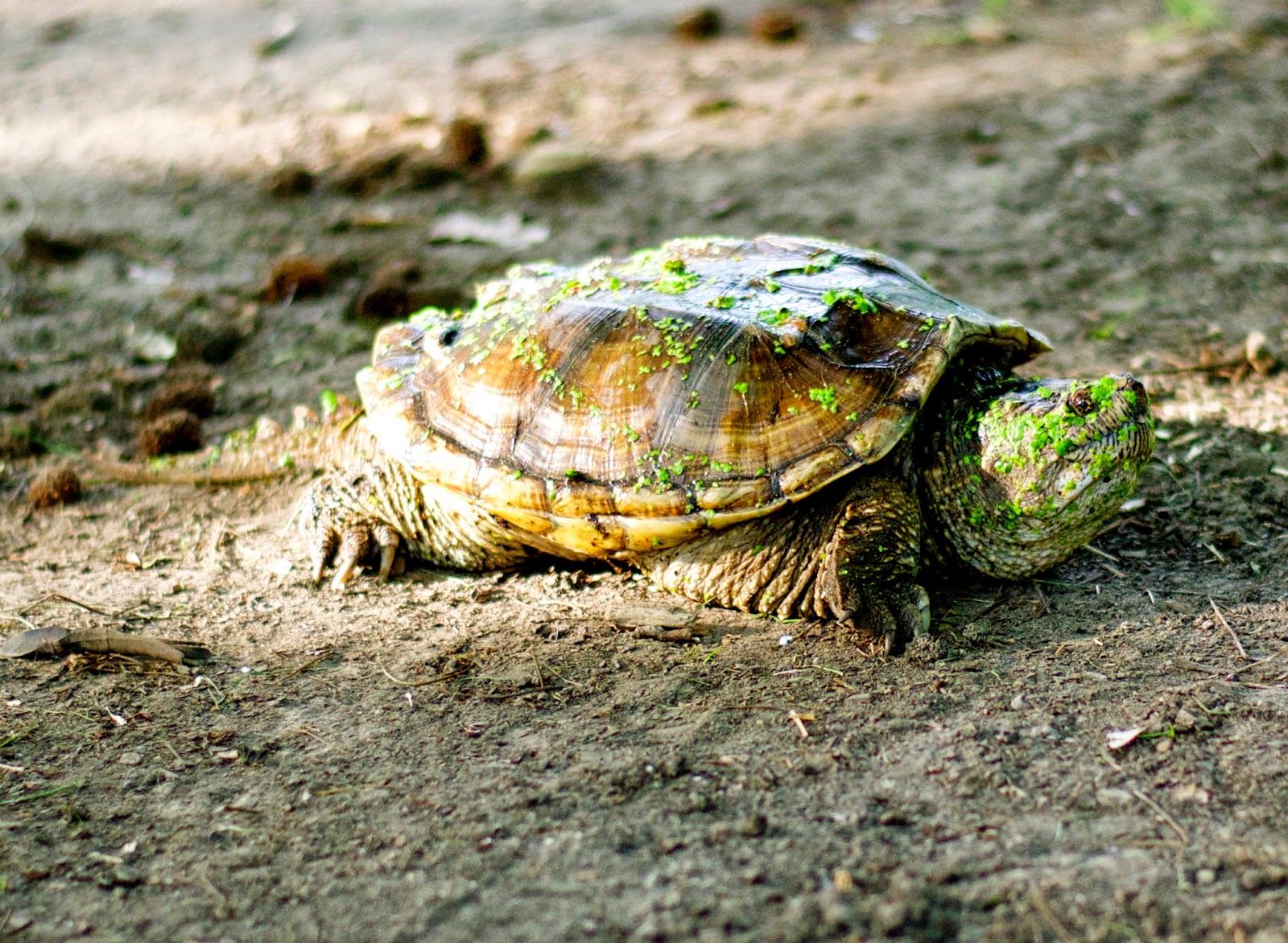
I had walked down a less traveled path toward the lake, it put me among reeds, where even a few cattails still grew among the invasive phragmites. I was hoping to see some frogs, but all I heard was a slurping/gulping sound. This snapping turtle was foraging on duckweed!
The entire Lullwater out towards where it meets the lake is COVERED in duckweed. Each little "flake" is actually an individual plant, it is not algae. It provides food for many animals, including ducks, for which it is named. Many don't realize snapping turtles are omnivorous, they will forage on plants as well as munching on insects, fish, frogs, ducklings, and any other animal that can be caught and eaten. 
A juvenile night heron is washed out by the low sun in the sky, but those red eyes stand out well. Right behind where he was sitting a wedding photo shoot was happening. I love that all this is still a hidden secret, unless you're looking for it, I could bet that most park goers don't know what is hiding in the trees, lake, and reeds right next to where they are, it always astonishes me, the things I can find here.

Wednesday, June 18, 2014

Turtle Traffic

     It's that time of year, female turtles are looking to lay their eggs. In order to accomplish such a feat, females leave their aquatic realm and venture into what is sometimes, for them, less familiar territory on land. In the city and developed areas this can be a problem, humans have built roads and turtles do not get along well with cars. It is a huge problem for turtles, especially at this time of year, many perish when crossing roads and trekking to find a suitable nesting site.
     In my 5+ years of commuting via bike through Prospect Park, I have often seen (and have even been called to help with) mother turtles either going to or coming from laying eggs. I specifically left for work early today so I could hopefully photograph the turtles of Prospect Park, Brooklyn. Prospect Park has in all of its waters, the popular pet and invasive, red eared sliders, which are highly visible and also nesting. I was hoping to see a common snapping turtle, and I did! I escorted her along and had some wonderful chances to teach people about her and her kind while doing so - enjoy her adventure below:
I literally walked into the park and right away saw a dark, slow-moving, hunched looking figure, I knew right away this was what I came for! I know that walk because when I was first dating my husband he allowed us to pull over to help an even larger snapper than this one across Route 104 in NY somewhere between Rochester and Oswego. When he asked if I wanted to help the turtle, that's when I knew he was a keeper! 
This girl has already crossed one pedestrian path and is just about to cross the bridle path here. She is still freshly covered in duckweed.

Many people don't realize a few things: 1. Turtles are reptiles, not amphibians - they may be amphibious, but so are ducks. 2. Turtles like all reptiles must lay their eggs on land, unlike amphibians the egg's shell is calcified and prevents it from drying out. 3. Common snapping turtles are native, they belong here and have always been here, unlike the red eared sliders.
That long tail, aside from the fact that this turtle can snap (and will), is what gives away this animal as a snapping turtle. It's Southern cousin, the alligator snapping turtle gets even larger- so large in fact that it is the largest freshwater turtle in the world. Still, many on lookers were astonished at her size, and surprised when I told them that she could still grow a bit more.
Thankfully Prospect Park drive is closed on the side she was on in the morning. I could have picked her up and helped her, but I didn't want to set an example that doing so in the park was okay, So I just walked alongside her. I slowed bikers down  and even asked a cop car to slow down - they smiled and waved, which I thank them for. 
Just about there!


She tried digging in a few spots but the soil was so compacted. I love turtles, and I don't see any ugliness. But the more I sat and watched, I felt like I was being transported back in time. Turtles and their kin have survived on earth for the last 200 million years, and we are finding even further back than that too
Attempting to dig with her rear legs, to no avail.

Her first dig site attempt, can you find her?
Being of the size she was, chances are this girl has been doing this for a few years now. Turtles tend to mature late in life, in comparison to many other animals. A turtle like this could easily survive for 50 years or more if undisturbed. Once this large, she has very few predators or hazards to look out for, mostly just people. She may lay 20 eggs or more, of those she is lucky if one survives to adulthood. Baby turtles fall prey to egrets, herons, and raccoons. But once fully grown they eat anything they can catch including ducklings!

With that leaf on her back, I personally see a stegosaurus...
Onto pedestrian Path #2, now moving closer to Prospect Park West... and my bike.
Why go around when you can just go under? 
     I want to also share that this turtle is a wild animal. Except for her escort across the street I did mind my distance, I used a 300mm lens, so that I could be afar and not disturb her but still was able to watch and photograph her. In my observations I noticed a few things that worried me. People did offer to pick her up, to which I said there was no need; I understand the need to want to help, but we should not ever interfere with nature unless there is immediate danger towards the animal. Not many know how to properly handle these turtles and many times injure themselves and/or the turtles. Many dogs were also off-leash, Prospect Park has off-leash dog hours but in specific areas, not where this turtle was. A dog who may wonder could injure the turtle or get injured itself, not to mention this is all right next to a major road, and an exit to that road and the dangers there for a dog are immense.
     I did have to leave the turtle after observing it for an hour - I had to be at work! To ensure safety of the turtle and park goers, I made sure to contact people who could help. A huge thank you to my friend Mary Beth and her friend Marty, who went to look for and provide safety to this animal.
     If you ever are on the road and see a turtle crossing, help when it is safe, because you are not going to be helpful if you too get hurt, don't ever put yourself in danger- call the professionals! Always help the turtle in the direction it is going, they are tenacious and on a mission to go in the direction they are headed, to bring them backwards will mean they will turn around to head back in the way they were originally headed. If you don't know what to do, contact your local animal rescue or wildlife rehabilitators, they will know what to do or provide you with guidance.
     If you would like to observe nesting turtles, they are most active in the early morning, but remember to mind your distance so the turtles can do what comes naturally! Happy Herping!

Monday, June 16, 2014

First Paddle of the Season

     It felt super awesome to get out on my kayak. Something I definitely couldn't imagine doing just a few months ago. Being able to lift my boat, strap it to the car, and paddle myself out in the salt marsh felt super empowering. Kayaking holds a special place in my heart, especially with my husband, who proposed to me - on a kayak! The salt marsh is wild amongst homes bordering it, one could take a turn down any of the small channels and enter a new wild place, the only reminders of the Island Park community is hearing a "Mr. Softee" ice cream truck in the distance. Herons, egrets, osprey, cormorants and gulls are encountered often. I was also very very happy to see some diamondback terrapins swimming in the water as well. It was a beautiful day and the sights were equally as beautiful...
A yellow crowned night heron nabs its prey- an unlucky crab. 
The lump in its throat shows that the crab has yet to give up...
I believe this wind-swept look is about as close to a heron glamour shot as one gets. These birds as their name suggests are generally more active at dawn, dusk, and even at night - to avoid competition with diurnal herons and egrets.
A snowy egret foraging in the mud at high tide.
The osprey were active, 4 were flying right in this area, where the nest is located. Young are most likely fledged and probably flying around the nest. This individual has what appears to be a fish in its talons.
Vocalizing.
There is something magical about egrets in flight...
This is a great egret, much larger than the snowy egret.

A snowy egret, for comparison. I love the water reflection on the underside of its wing.
they forage in the stickiest mud and muck, but they always are pure white and beautiful.
One last osprey fly-by as we paddled back in.

     I cannot recommend a paddle any more highly. For a lovely paddle on a lovely salt marsh, through some lovely people - I cannot speak any better of my experiences at Empire Kayak - check them out and go explore!

Sunday, June 8, 2014

Long Island Lizards

     I remember distinctly the day I got my Peterson's Reptile Field Guide. I was in middle school and my dad had just taken me to a Long Island Rail Road station in Westbury, the town just North of ours. He took me there because he had learned lizards lived there! Nerdy-awkward-middle school me easily agreed to go take a visit. All along the South facing sides of the station that slope up, from the parking lot to the tracks were covered in small brownish green lizards. It was the coolest thing ever, especially having never ever seen anything remotely reptilian anywhere near my home. My dad said we needed to find out what it was, so we took a trip to local Banes & Nobel and found it in a field guide, which was then purchased for me as a gift, that I still have to this very day.
     The Italian Wall Lizard we learned was introduced and lives exclusively in Western Long Island, NY and some random other places. They were introduced here in the late 60's and have done quite well for themselves. These lizards seem to use the Long Island Rail Road tracks as a mode of dispersal - an interesting article about them provides some more insight on these lizards, by Russell Burke of Hofstra University.
These lizards are naturally found in Italy as well as France, Switzerland, Coatia, Slovenia... but have been introduced on Long Island.
They are normally found in rocky, scrubby habitats-- the dried dead grasses and gravel of the sloping sides of the railroad station simulate that habitat, with a lot more added Mc Donald's cups and other wrappers and trash....
I appreciate finding things in unlikely places, and this is as unlikely as it gets. Across the tracks, ladies in hats were waiting for a train to take them to the Belmont Stakes-- I was the crazy lady looking over the railing and stalking lizards... 
These lizards can vary in appearance, bu overall, they are brown with those dark blotchy lines down their back with green above.
They are part of the lacerta lizard family- lizards normally found in Aurope, Asia, and Africa - and like their counterparts, sport a mini forked tongue.

The large circle behind their eye is where their ear is located- unlike us, they don't have pinnae (the flap of skin that makes up what we call our ear).
A wall lizard doing just as it should- hanging out on a wall. They fit quite well into all the cracks and crevices. 
A good example of how well they can squish into the wall for safety. To compare, those are pebbles, these lizards are not large at all. Their predators here on Long Island include house cats and birds.
I wonder how many people commute from here each and every day... and I wonder how many of those even take a moment to notice that lizards are running all over the place. I know if it were me, I'd probably miss my train often...