Our first full day in the Cape actually took us off the Cape with
Hyannis Whale Watcher Cruises. I think this is the same cruise I went on 20 years ago with my family. This was back in the day where I wanted to be a marine biologist, study dolphins, I'd read books about whales to my Gma for summer reading, if it had to do with cetaceans, I was on it. I wish 9 year old me was able to witness what I did on this day's expedition, heck, I think 9 year old me did, because I was pretty freaking excited to be in the presence of these whales.
I'm not going to say too much here, I'll let the pictures do that.... oh, and there are A LOT, you've been fairly warned:
 |
| The first species of whale we saw were fin whales, the second largest living thing on Earth after the blue whale. |
 |
| In between whales, I did some bird watching. hoping to see some pelagic species to cross off in my field guide. This species, the common tern was fairly abundant on today's cruise. I thought I saw a black tern, and then the guide on board confirmed that for me as she announced it after I saw it. Also spotted was an Arctic tern, but I did not get to see, so no check for that one. |
 |
| Both whales and fishermen were after the same prize. It was crazy how close some boaters whizzed by these whales, which is a worry as whales can and do get struck by boaters not attentive to their surroundings and who they share the water with. |
 |
| I learned that fin whales, despite their massive size, are fast, and they displayed that for us, changing direction quickly and moving from one place to another in a short time. |
 |
| These whales are asymmetrically colored and their coloration, these white blazes along their side, can be used to identify individual whales, which the crew on the boat were able to do for many of the whales we observed. |
 |
| We also saw humpback whales, which are well known for their picturesque dives, exposing their flukes (that's the tail). |
 |
| Humpbacks are also individually identifiable, each has their own unique underside of their flukes. Many humpbacks are given names or ID numbers. These are the flukes of "Rocker." Who was swimming with another humpback, named "Abrasion." |
 |
| Many humpbacks also can also be identified by their small dorsal fin. The hump the precedes the fin, is how the humpback got its common name. |
 |
| Humpbacks have HUGE pectoral fins (those are the "arm" fins) that are primarily white and appear greenish when the whale surfaces to breathe. Both humpback and fin whales are baleen whales- these whales have double blowholes, which are really just the same as the nostrils on your nose. Toothed whales, like dolphins, porpoises, sperm whales, etc, have a single blow hole. |
 |
| A nice lifer- a greater shearwater, a pelagic bird- meaning it spends the majority of its life out on the ocean, usually far off shore. |
 |
| Greater shearwater are on the left, and two Cory's shearwater on the right, just bobbing around on the water. |
 |
| Two Cory's shearwater take off, in order to fly, these birds get a running start on the surface of the water before becoming airborne. |
 |
| Our cruise left from Barnstable, MA, we quickly made our way out from Cape Cod Bay out toward Provincetown. We didn't really have to go much further from there. The whales were right off shore, feeding and this gives you an idea of how close to shore we were. The large finback was in full feeding mode and put on quite a show for us as you will soon see. |
 |
| A common tern gets lucky and a juvenile gull tries to make a steal. |
 |
| Common tern. |
 |
| Fish congregated in what are called bait balls. They school closely together and hope to find safety in numbers, hoping that the fish next to them gets eaten instead of themselves. Birds congregated and opportunistically got in on the fish feeding frenzy. Shearwater, gulls, terns, and possibly other species get in on the action. |
 |
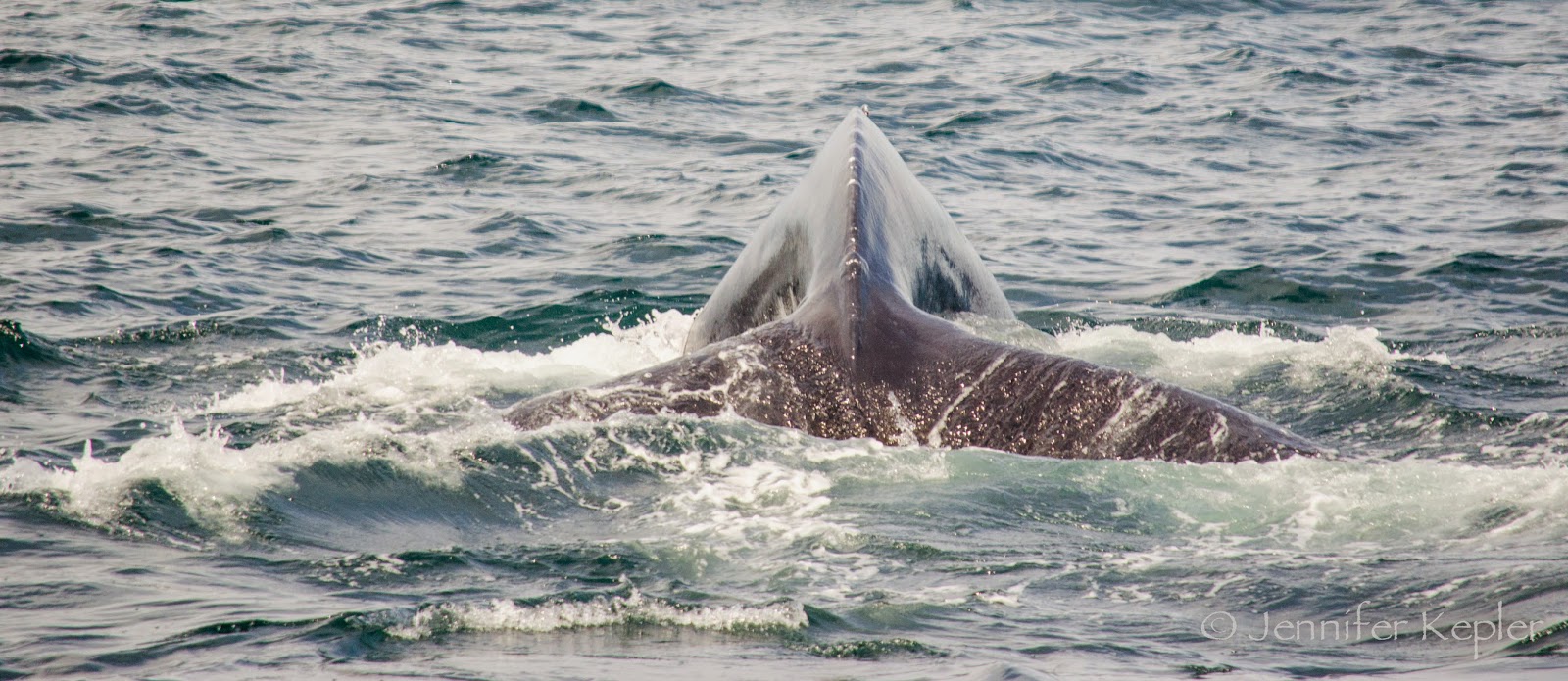
| When fin whales feed, we learned, and saw that they use behavior called "lunge feeding" to scoop up fish. In lunge feeding the whales circle, then quickly lunge, with their mouth open, swimming on their sides. It gives you a chance to see their flukes and that white blaze on the sides of their bodies (the green underwater). It was a very cool behavior to witness in person. |
 |
| A greater shearwater runs forward to take off. |
 |
| Lunge feeding just off shore! How cool is this?! |
 |
| Fin whales usually swim solo, but form associations with others from time to time, just swimming close to another, diving together, or feeding together. |
 |
| I love how you can see part of the head of the further back whale. |
 |
| Two fin whales feeding together, side by side. Fin whales, humpbacks, blue whales, minkie whales, sei whales are all rorqual whales. They have baleen that hangs from the roof of their mouth to help them filter their food from the sea water, but they also have grooves on their throat. These grooves allow their mouth to expand and fill with water and food, they then push the water out to swallow the remaining food. Other baleen whales, like right, bowhead, and grey do not have these grooves or an expandable mouth like the rorquals. |
 |
| A nice flip and slap of the flukes by one of the fin whales. |
 |
| They also surfaced below the bow of the boat. Their breath is so loud and surprised all of us. There is nothing to compare being able to see this animal up close, seeing how massive they are, words cannot describe. |
 |
| A first year Northern gannet. These birds are related to boobies and are amazing divers. |
 |
| A different humpback on our way back in, "Freckles." Note the green, marking where her large pectoral fins are located underwater. |
 |
| We learned you don't see flukes every time a humpback comes up to breathe, you only see them when they make a dive. Dives are marked by a large arch of the back, with flukes to follow... |
 |
| The unique fluke patterns of "Freckles." |
 |
| "Freckles" is easy to identify because in addition to her fluke patterns, she also have some white markings on her dorsal fin, hence the name "Freckles." |
 |
| "Freckles" surfaced and dove close to our boat, giving a nice close view of the typical rough edges of a humpback's flukes, as opposed to the smooth edges of the fin whales flukes. |
The whale watch was fantastic and the naturalists on board were very knowledgeable. I appreciated the information they shared, and it was great to get to know some of these whales on a first-name basis. We got to see some interesting behaviors, and we also saw a third species, the minkie whale. It was very surreal to be surrounded by some of the largest creatures on Earth, it really puts you in your place, as a small primate in comparison!
I also appreciated that the crew educated others not on board, instructing other boaters to slow down or to idle their engines to avoid whales getting injured from the fishermen and casual boaters sharing these waters. The Hyannis Whale Watcher Cruise boat abides by the rules, regulations, and laws (
Marine Mammal Protection Act) put out by NOAA which I appreciated. I highly suggest a ride with them, each cruise is different, you never know what you're going to see!