Saturday, February 14, 2015

The Great Backyard Bird Count: Day 2 of 4 - Snipe!

The Great Backyard Bird Count Weekend Continues!
     After a successful day yesterday, finding lots of bald eagles, I was not hoping for much today, but in just an hour and a half at Marine Park I saw 21 species, 1 of which being a lifer, and of all 21 species, 4 were a few different types of raptors.
     Today was much warmer than yesterday, but grey skies threatened with snow, which it did end up snowing when I left. Much of the water was frozen, with a few open spots that almost all had waterfowl in. The raptors were all actively hunting, smaller birds were foraging in secret, trying not to be spotted, and the waterfowl were busy flying in or moving out to another area.

Enjoy:
This rough-legged hawk was actively looking for food over the field of grasses and reeds on the east side of the Salt Marsh Nature Center. This bird did a lot of hovering and soaring in place, scanning and then moving over a little bit only to repeat, until he or she looked over the whole field, and would then repeat back where it began.
How to tell the difference between your hawks? We mostly are used to seeing red tails, red tails do not have such a dark band across their belly like this bird does, which is a typical field mark for rough-legged hawks. Red tail hawks also would sport a red tail (as an adult) or a brown, barred tail (as a juvenile). The red tails would also not have those dark patches at what is equivalent to their wrist.
I think we might be observing each other. Another rough-legged hawk was just across the water over an old landfill, also hunting, and was later joined by this bird. Once this bird left its current position over the field I was hiking along, a red tail hawk immediately filled the niche and began hunting for itself.
Savannah sparrows, song sparrows, and some American tree sparrows laid low in the grasses to hide and feed.
An American tree sparrow cautiously comes out onto the trail.
An American Kestrel scored a meal of a rodent. These birds have amazing vision and, like most birds, have the ability to see into the ultraviolet spectrum. The ability to do this helps them hunt, as rodent urine reflects UV light, so these birds can follow a rodent trail (because they mark their territories with urine) to the trail maker.
Gangway! Comin' through! Canadian geese make a splash into one of the few areas of open water. 
Almost didn't see this killdeer and its conspecific until I heard them give their "Deer-deer-deer" call. 
A good way to end my adventure today- a Wilson's snipe! This bird has been continuing in this area since early February. I was glad to have spotted and photographed him. This bird is a lifer for me and will get a mark in my field guide, except my field guide is so old, this bird was not considered a separate species from the common snipe, until 2003. My parents gave me my field guide in 1997. I think I will have to tape a photo of him in and check him off!

Friday, February 13, 2015

The Great Backyard Bird Count: Day 1 of 4 - EAGLES!

     Today, 2/13/15, through Monday, 2/16/15 is the Great Backyard Bird Count (GBBC). I also happen to have a 4 day weekend, so that is perfect!
     If you do not know what the GBBC is, you should, because anyone can participate. The GBBC is a citizen science event, citizen science is science ANYONE can participate in. Any person, scientist, secretary, or student can submit data that is used by researchers and different organizations to conduct various studies and/or look at trends in populations of animals. Being a citizen scientist is important, it's great to be involved in data collection, it is wonderful to know you are contributing, and it's fun!
     For the GBBC all one has to do is go outside, anywhere, and look at what species of birds they see and how many of each, then submit them into eBird. It's that easy! If you are not an expert birder, that  is okay, neither am I! I still second guess certain birds and still rely heavily on my field guide for ID help. Cornell has developed an app, the Merlin app, to help with bird ID's for novices that could help you along your way, if you do decide to have fun participating in the GBBC!
     Since I had today off, and Tim did not, I decided to take advantage of some upstate birding, and specifically was interested in seeking out eagles. I visited 2 sites: On the East side of the Hudson River, Croton Point Park, then on the West Side, Hook Mountain/Nyack Beach Park. It was cold, but I layered, and had a good show in both places I visited.
When I drove into Croton Point Park, I immediately saw a juv. bald eagle, it flew by me a few other times too, but it was a sign that today would be exciting. I was welcomed also by some American tree sparrows feeding with a mixed flock.
This horned lark fed with the tree sparrows and some song sparrows as well. The foot print this lark is in helped to uncover some grass, which these birds need to feed, as they forage for seed.

Ice forming on the Hudson River.
The wind chill today was in the negatives, when I was out, the temperature might have been 9. I had a lot of layers, and was surprisingly comfy.
After a third pass, I finally got an alright capture of the juvenile bald eagle that I saw when I came into the park.
That Ice is the shoreline of the Hudson River.
A downy woodpecker foraging for food.
Next stop was Hook Mountain, in Rockland Co. on the West side of the river. Again, as soon as I pulled in with the car, already had an eagle flying through the trees.
The eagles here were active, perching on Hook Mountain then flying off.
Also had 3 ravens coming through where I stood pretty often 

The Arctic or the Hudson River?

These eagles were very active, they also vocalized a lot. If you ever have the chance to observe eagles in the wild, really, please get out and do it. Listening to AND seeing these birds gave me chills, not because it was crazy cold out, but it's just so amazing to experience!

An adult and juvenile eagle perched atop Hook Mountain.
Bundle up and get your count on! Use the various links at the top of this post to get yourself started in becoming a citizen scientist!

Sunday, February 8, 2015

More Brooklyn Firsts!

     Today it finally got above 40 degrees, the snow and ice got a chance to do some melting, and heck, later today, rain will be on the way! So why not get out with minimal layering and enjoy it while the mild temperatures are here!
     Today was double header, first I walked in my backyard, Green-Wood Cemetery. I encountered life, death, and survival among the birds I came across. Nothing super out of the ordinary, but a raven was nice to see and hear.
     After coming home I decided to head out again to Bush Terminal Park, where there have been some reports of rare birds and it was definitely worth it for myself as I had three Brooklyn firsts (2 of which were first ever firsts).
All life has to end. I was startled to see this red bellied woodpecker, and of course I had to examine. This bird was not killed by another animal, this bird may have simply died of old age or succumbed to the weather or may have not been able to find enough food. Winter is rough for all species, but I saw many other red bellies hacking away at trees, foraging for food and continuing the fight to survive till spring when more insects will come out of hiding and provide more food.
A song sparrow takes advantage of finally exposed grass to forage for seeds and possibly insects that took refuge in the decaying leaf litter before the snow.
A raven made an appearance, calling its deep, raspy, low call. At first I thought it was a heron calling! Ravens, appearance-wise have a longer, wedge shaped tail, and longer, more slender wings.
My next stop was Bush Terminal Park, and to my surprise, a hauled out Brooklyn harbor seal! This would make for my first Brooklyn Seal. 
I call this the "banana position" because, well, look at him! Harbor seals migrate here in the winter, more and more seals have been spending time down this way. It means a few things- the seals are doing well, they have a large population and need to spread themselves out. It also means our waterways are getting cleaner, cleaner water means more fish, more fish feeds bigger fish and bigger animals. It is great to see these guys in our water but it also means we need to be more careful with boat traffic, how we dispose of trash, and how we dispose of our fishing tackle and gear.
One of these gulls is not like the others... Second gull to the left is a continuing glaucous gull, an Arctic bird that we don't see to many of 'round these parts. Similar to the Iceland gull I saw last week, but with a few minor differences that equate to a completely different bird.
Unlike the Iceland Gull, the Glaucous Gull has only the very tip of its beak as black and that beak is longer, also its forehead is more sloped. Both these birds in Brooklyn are in their first winter plumage- adult plumage would have other differentiating field marks.
A double crested cormorant joined my seal friend.
Oh and the seal and gull are just located behind all this, the warehouses of Western Brooklyn 
Another first for me, not one, but 6 American tree sparrows, foraging in the grasses of Bush Terminal Park.
Some distinguishing marks, no belly streaks, just a spot in the center of the breast. Also that red cap and buffy clay/red color on its sides. A handsome little bird!
Side view, just a pretty little sparrow! Happy to learn more species of sparrows by seeing them in person!
A great cormorant overlooking a very hazy New York Harbor. These birds breed up in Maine and Greenland, and quite a few come down to spend the winter in our waters. One distinguishing feature, aside from their larger size when compared to double crested cormorants, is that white patch at the throat and lower bill.

Monday, February 2, 2015

An Old Friend

     Today I worked from my old digs at Central Park Zoo, in Manhattan. The day began as rainy in Brooklyn. I came up from the F train at 57th street to ice. The ice was so intense that I could not fold up my umbrella as it was covered in a sheet of ice. By 1:30, the ice changed to fluffy snow. The snow was beautiful, but the weather combinations made it not so fun to walk around.
     One thing I was looking forward to seeing, aside from my favorite zoo animals was a house sparrow. What could be so great about a house sparrow? Well this one is different, he stands out from the others and he has been living at the zoo since I began working there in 2011. I kept an eye out for him when in or around the zoo. I saw lots of other birds seeking shelter from the weather and hoping for a free meal from the zoo birds. But would I see my favorite sparrow?

I took a lunchtime walk through the zoo, seeing the animals and any wild wildlife doing their thing in the falling snow. Biru, the red panda is right at home in this weather.
A grackle grabs some fresh water, a lot of the fresh water sources out in the park are becoming more and more, if not completely frozen over.
A snowy squirrel wonders where all the tourists are that feed him all the time. Gotta revert back to his wild squirrel ways...
White throated sparrow in the most Southern end of Central Park on my walk to the subway to go home.
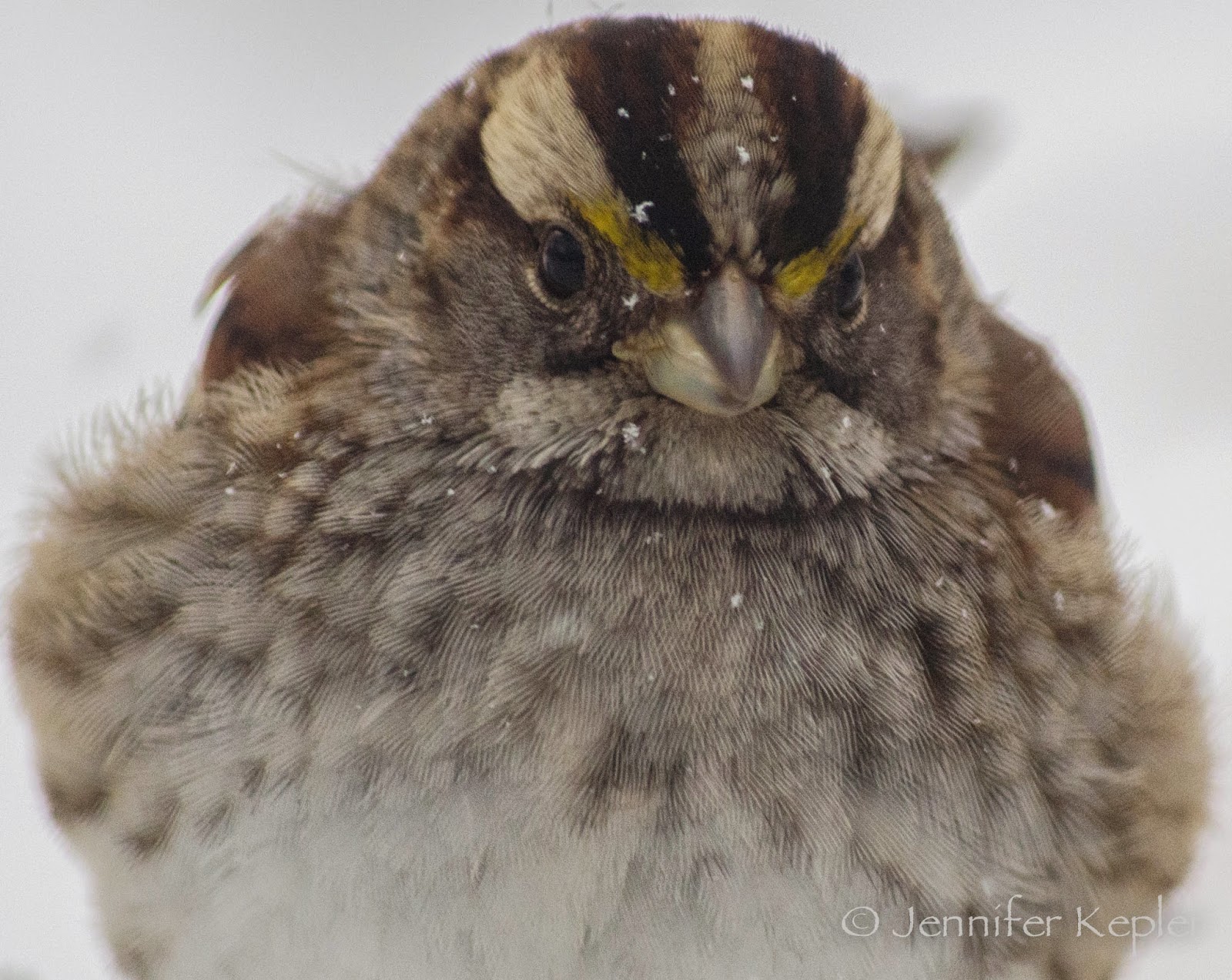
A white throated sparrow assumes the floofy look, this helps to trap air between its skin and feather to insulate and keep warm.
A lot of white throated sparrows out today... And not shy at all, or just too cold to move.
 And then, as I exited the park, I saw a group of house and white throated sparrows feeding on a pillar. And who was there in the group? No other than my most favorite house sparrow! Was so glad I took a long glance before crossing Central Park South, because I do love seeing this little male sparrow:
This sparrow has some piebald on its wings, its primary flight feathers are perfectly white. He is gorgeous in flight, flashing white.
I love finding something exciting in the ordinary everyday. I love that this little sparrow is still frequenting the same area for the last few years. Here is a post I made about him over a year ago.
Just doing his thing, surviving like the champ he is. 
 Seriously, seeing this little bird was one of the highlights of my day. I used to see him every day when I worked at the zoo, so being able to see him today made me smile.


Saturday, January 31, 2015

More Arctic Birds in the BK

     Last weekend, a snowy owl at Floyd Bennet Field brought a little Arctic flare to Brooklyn, but reports have been coming in for the last week, week and a half about another Arctic visitor, an Iceland gull.
     People usually don't give much thought to gulls, that are often labeled across the board as "sea gulls." But not all gulls live by the sea, they can be found many many miles from it, they can live near freshwater, brackish water, and near salt water. And my favorite kind of gulls are the ones that live on bays, they go great with some cream cheese and lox. (See what I did there??)
     So the everyday people just see "sea gulls," but if you take a closer look there is more than meets the eye. I will say, generally, gulls have a very similar appearance among them regarding shape, coloration, and behavior- and heck, sometimes even sound. They even vary within their species, because they way they look can tell you approximate age, and if you aren't paying attention to the weather, the season, based on their plumage.
     The Iceland gull, while very different looking, in a birders eye is admittedly hard to first spot when the birds around it are in general, similar. But once you find it, you can't stop thinking how much this gorgeous bird stands out from the crowd.
     Oh yeah, and YAY, this one is a lifer for me! This gull gets a mark in my book.

WARNING... a lot of pictures of gulls ahead...

Guls overhead and all around! Juvenile ring billed gull.
1st winter Iceland gull- if you'd like to understand plumage terminology- I found this helpful.  
Iceland gull flying by at eye-level.

It felt like Iceland. The wind was blowing and the temperatures took a plunge today. I was wearing three layers for pants, double layer socks, with my super-duper winter boots. Glad I made such choices. Salt water requires lower temps to freeze, so here you have it, frozen salt water in Gravesend Bay proves it was darn cold out there!
Brant flying in to rest on the bay.
Ring billed gulls - compared to the Iceland have black markings on wing tips and tail, also they are smaller in size.

Oh yeah, this is also where I am birding from. Very unassuming, a shopping center, Caesar's Bay Bazaar in Bath Beach.
Many flyovers by Canadian geese.
Iceland Gulls do come from Iceland, but the gulls from Iceland migrate to Europe. This Iceland gull probably originated in the high Arctic in NE Canada. They migrate south but spread themselves out very sparsely, so they are considered a rare sight for the area.
More info on Iceland gulls can be provided here, via Cornell.
These gulls, including the Iceland, are omnivores, but uncooked rice and rice cakes are on today's menu. These food items are not recommended for wild birds.
Scoping out competitors for food.

I approched a few folks and spoke to them why spreading bread, rice, and other "human foods" are bad for wildlife. Half these foods aren't really good for us. Also, if these foods are past date, or lay around gathering mold, it can lead to birds getting Asper, a fungal infection that will kill. The DEC provides plenty of reason why feeding birds bread and table scraps are not good- specifically to waterfall - but this goes for all.

This provides an excellent chance to see the Iceland gull compared to a juvenile (right) and adult (bottom) ring-billed gull. The Iceland is much larger, even though it is further away, also no black markings on feathers, a thicker bill that seems shorter too.