A three day weekend, plus some catching up from the week...
On Tuesday, 9/1/15, I got the chance to work on board a whale watch for work, teaching the passengers about marine mammals- adaptations, conservation issues, and their behaviors. Unfortunately we did not see any marine mammals, but before we hopped on board, I caught a monarch fluttering furiously over some milkweed near the port...
 |
| She would land on each milkweed for a short period. Here I caught her resting, then she was back at it... |
 |
| She would reach her abdomen around and under each leaf and I figured she must be laying eggs! This milkweed is sadly small, and an unfortunate egg location, but she also did this to many other milkweeds adjacent to this tiny little one. |
 |
| Butterflies can taste with their feet, and I wonder how they know which plant exactly is milkweed, she came over to these with what seemed like very little doubt about what plant they were. |
 |
| And here is one of her tiny little eggs on the underside of a milkweed leaf. I have never seen a butterfly lay eggs, nor have I ever seen a butterfly egg. This was the best part of that day, for me! |
On Saturday, 9/5/15, I got up (really) early and joined a fall migration Brooklyn Bird Club walk in Prospect Park. Got some birds I haven't seen in a while, like parula and prairie warbler, also some nice looks at ruby throated hummingbird and hairy woodpecker. I totaled 31 species of birds, also spotted some nice insects, like a digger wasp and I had the chance to talk insects with some of the folks on the walk. I often doubt myself in IDs among birders, I fear being wrong (it's a really stupid way to feel), but it felt awesome to shed some knowledge on insects with folks, although I'm far from entomologist status, I'm (always) still learning. Here are some highlights I was able to capture via camera...
 |
| A ruby throated hummingbird feeding on flower stop lookout hill. Lookout was mostly dominated by American Goldfinch, but also gave us great looks at a peregrine falcon, black-throated-blue warbler, and a mob of crows going after a mystery bird/raptor we never got our full sights on. |
 |
| A summer azure landed near the drinking fountains on Wellhouse Drive. |
 |
| Before leaving I just wanted some satisfying close and clear shots of something. So a flock of foraging house sparrows fit the bill. Amazing that these little invasive critters are having trouble in their native populations back over in the UK. |
 |
| Female House Sparrow |
I took a day off Sunday, because well, we went to a wedding the night before and the couch was about all I could fit into my day on Sunday. So today, while Tim went to the driving range, he dropped me off at the Salt Marsh in Marine Park and I got in a little walk that I think made up for my lack of energy yesterday... And apologies in advance, too many (never too many) osprey and marsh wren photos ahead:
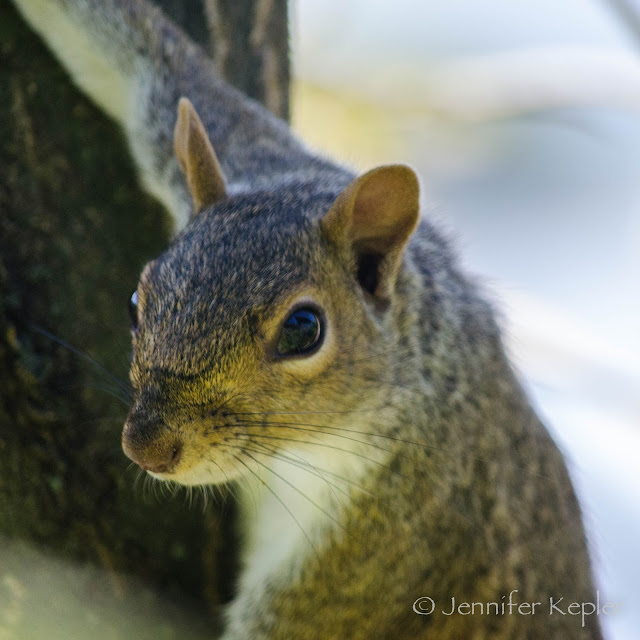 |
| "Hey lady, you bird 'round here often?" I wear my hair down one day, and I got Rico Suave Squirrel here... |
 |
| One of the osprey pair was out fishing over the Mill Basin, very active, swooping and hovering. It did not make the gulls happy. Before you knew it this bird was surrounded by gulls who did at some points pursue in and slowly moved it up ove my head and back out, down towards the Belt Parkway overpass. |
 |
| I love raptors, I love their wings and those yellow eyes on the osprey! |
 |
| Eye contact. He totally sees me more clearly than my camera can capture him/her. Their eye sight is amazing. |
 |
| Perfection! Even with the funny tail feather action there. |
 |
| Flyby past the late morning moon, perfect! |
 |
| This little patch of flowers along the trail was full of pollinating insects. I have decided I have become far less fearful of bees, wasps, and hornets. I have found the more I try to ID them and learn more about them, the more amazed I am by them and less scared of them I am. Like this Great Golden Digger Wasp, a wasp that simply eats nectar as an adult. They capture and use their paralyzing sting to immobilize crickets which they deposit underground with an egg, so their larvae can hatch and feed on the insect, caught just for them in a chamber underground, where they are safely packed away. But to me, they have no interest in me, and knowing about them makes me feel much better. |
 |
| These are solitary wasps, meaning they don't live in a huge colony or nest. And look at that cute little nectar sipping device! |
 |
| I was in the middle of trying to capture this American Sand Wasp, until I heard a funny little bird song-- like really whacky... |
 |
| ...And out pops this little job. |
 |
| This Marsh wren (accompanied by another, who remained mostly hidden) came out atop the reeds, sang is funny little song and really gave me a great look at him, from not too far away (just across the path). |
 |
| I especially loved the marking on his shoulders and neck, they almost felt iridescent or fluorescent-- very beautiful and boldly marked. |
 |
| As his name implies, here he is, living in the salt marsh. With his little upright wren tail. |
 |
| Squee! Singing his (teenie tiny) wren heart out. Birds have a syrinx- which allows them to sing two different notes at once, this little guys song is a perfect example of their ability to do just that. The sounds coming out of this tiny little thing was pretty amazing. |
 |
| I love when they sit like this, reminds me of one of those singers at the jazz club, crooning into the mic. |
 |
| A perfect little thing! The Marsh Wren. |
 |
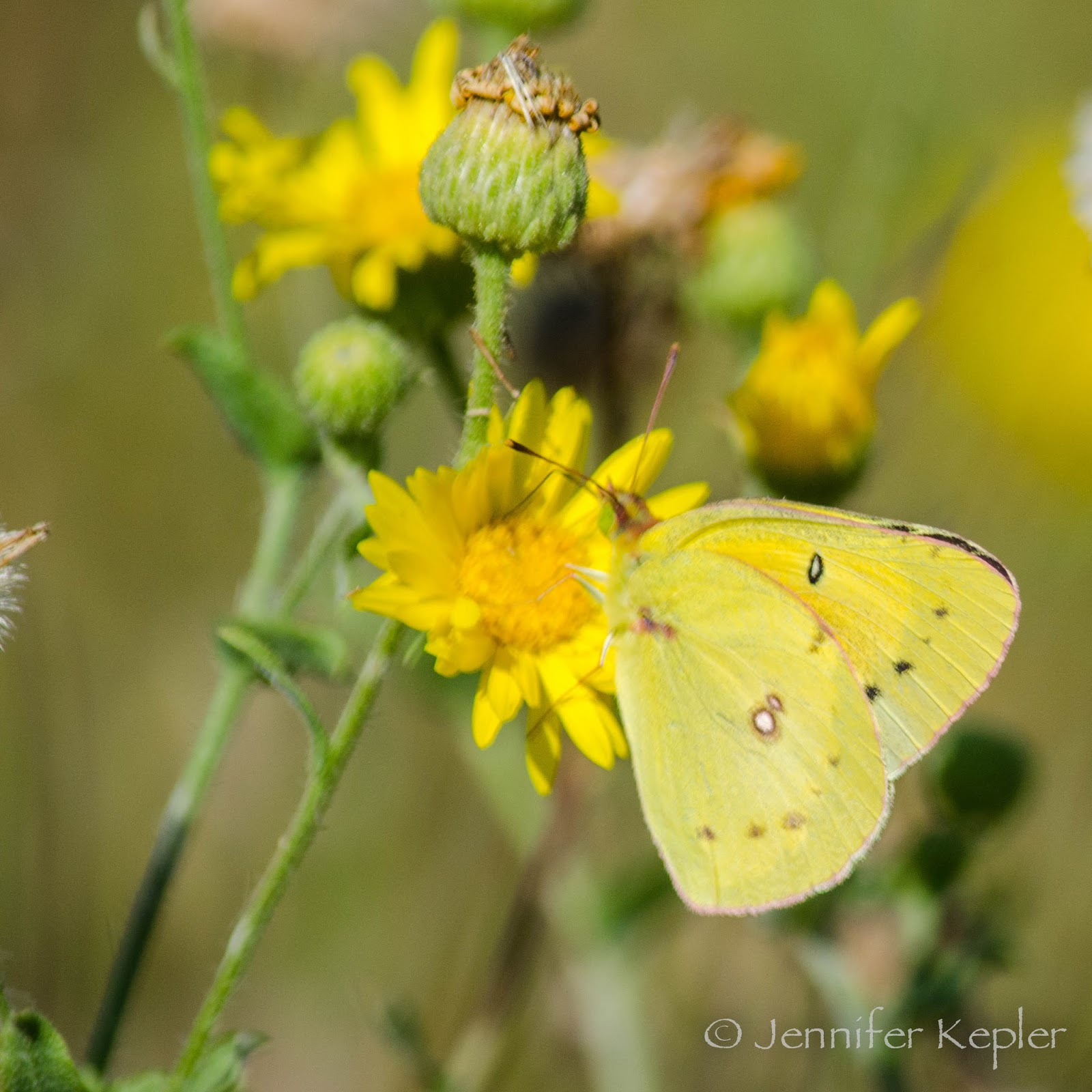
| A clouded sulfer feeding. |
 |
| A black-and-yellow mud dauber. I learned these are not aggressive and rarely sting. Normally I would not stick around to watch these guys, but today I decided to. This individual was very interested in this orb web. I also learned those little mud pipes are made by these guys and they don't live in them, they just lay their egg in it, and leave inside it paralyzed spiders (ah, I see the fascination with this web...). The larvae overwinters in that little mud nest and emerges the next spring. Like, really-- how AMAZING is that?! My appreciation for this once scary creature has increased immensely! |
 |
| Curious about that web, are we? |
 |
| Looking for a spider... and when you think about it-- this is simply a mother insect helping to care for its young. When you think of it that way, it really makes you see these animals are much more complex than a "scary bug" (a bug, which it is not, technically). There is something sweet about when you just think that this is just a mother out grocery shopping for her little babies. We care for our young, did you know insects too, could be so caring?? |
 |
| Some good views of a greater yellowlegs on the exposed mud near the green bridge in the marsh. |
 |
| Now these, there are true bugs. These are the nymph stage of the large milkweed bug. They use their proboscis to feed on the sap of the milkweed seed pods. |
 |
| A cabbage white feeding. Not a moth, very much a butterfly. |
 |
| Originally did not notice, but this little pollinator (literally) holds a clue to its identity. I realized when editing my photos this bee was holding a piece of leaf. Did you know there is a whole family of bees called, leaf cutting bees? Magachilidae. I am very certain this is the Common Little Leaf-Cutter bee. Look at how many there are on this awesome site, the bug guide. What a fun find, I'm so happy to discover a cool little insect I have never known before! |
 |
| This Orange sulfur seems to know that this flower just makes it look absolutely fab... |