Wednesday, July 27, 2016

Colorado Trail, Days 2, 3, & 4

     Much of our time on these days was spent (in the order that follows), waking up for good (since you got zero sleep on the ground overnight), get some breakfast and eat it fast --because your mess kit is metal and therefore cold and holds zero heat, pack your lunch for the trail (pack a lot, work makes you hungry and salty snacks help you stay hydrated and I rationed my food out over 3 breaks), hike out to the trail (approx. 1.5-2 miles one way) and work till about 3:30-4pm, hike back to camp, clean-up (new clothes that are not covered in soil and if you're lucky, a baby wipe bath), get a delicious dinner - we ate like kings and queens, we had stir-fry, salads, and spaghetti, to name a few-- oh and every dinner included dessert! Then as light faded, so did the crowd. With no fire to stay warm around (a fire ban was in place due to dry conditions), we went usually to our tents, but after dinner some folks hung around for card games, a beer, or to talk about anything and everything.
     In any free time I had, I also explored, we hiked the second evening to Hancock Lake, in hopes of seeing a moose, we ventured over to the ghost town of Hancock, and looked for wildlife in and just beyond our camp. What a treat it was to live among all this for a short time, because let's be real, nothing is better than a clean bed after a real shower!
     Enjoy the sights:
My best match for this one is an Arctic Fritillary.
It also happens to live in alpine and subalpine meadows, pretty much where we were!
This is most likely also an Arctic Fritillary or a subspecies, purplish fritillary, I only saw its underside...

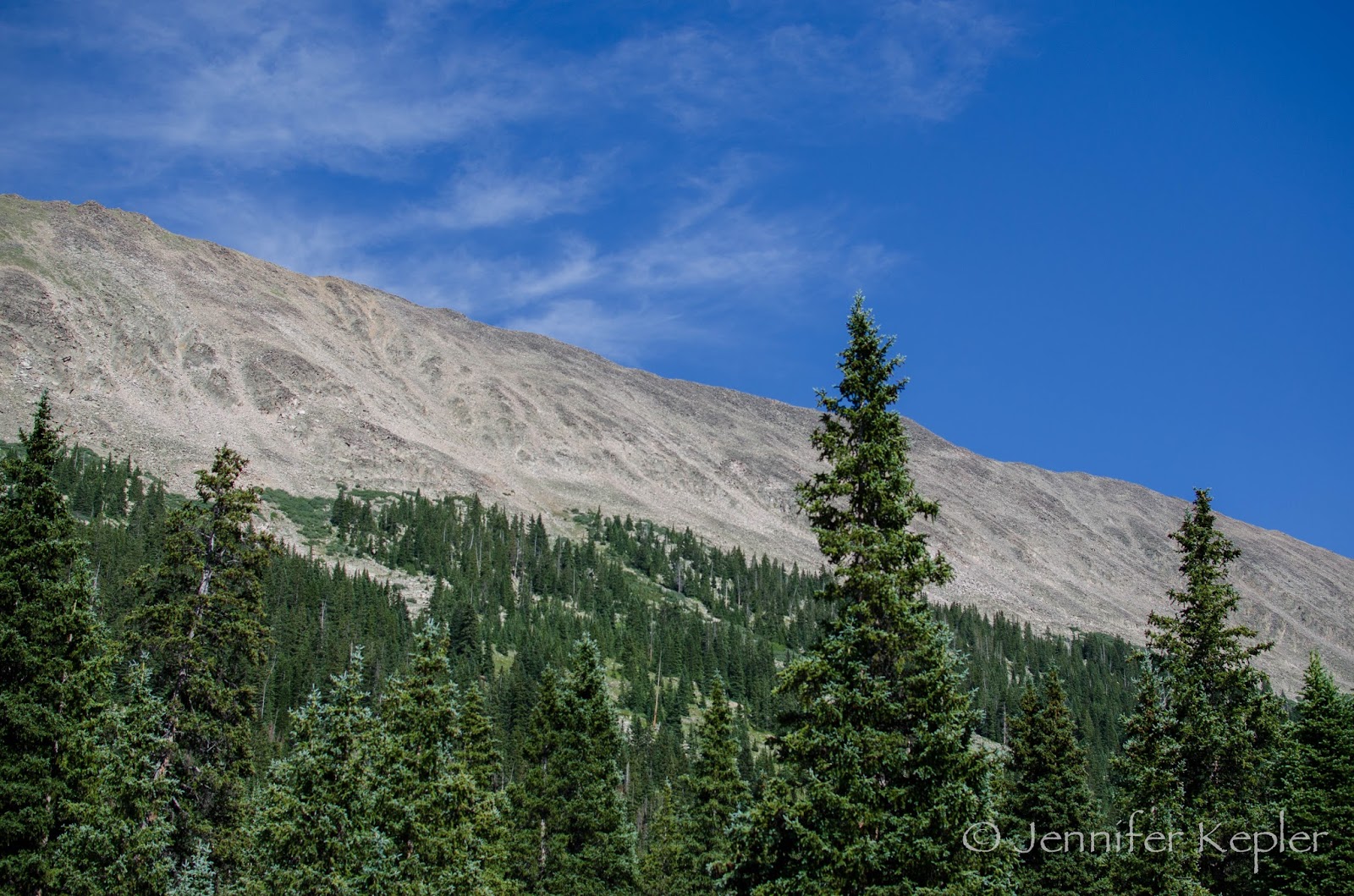
Ice and snow packs continue on most peaks around us.
This is all that remains of the old town of Hancock. Hancock was a town built around the railway that stopped running through the area in 1910. People living in Hancock helped build the Alpine tunnel and some mined in the area, but once the railway discontinued, so did the town. All that is left is some of the old saloon.
Moonrise over Hancock Lake. No moose were seen, but we got this amazing moonrise.
Woke up to a cold Monday morning, and took a crappy, far-off picture of a bird, but sometimes a crappy shot is all you need to get an ID...
A little zooming in reveals a gray jay! These birds live in high mountain and spruce forests-- hey, that's where we were! This was a very cool life bird to add to my list!
A mule deer makes her way through our camp with little care for us and what we are doing, which at the time was cleaning up after dinner.
On the road just outside our camp I found some amazing yellow-rumped warblers, the ones out west are absolutely gorgeous, looking like a different birds from the ones we have in the east! This plumage is known as the "Audubon's" variety.
Man, is he striking! I also saw a mountain chickadee and hermit thrush, singing their beautiful song all over the forests.
Lots of red squirrels in the area, we mostly heard them, with their rattling alarm call. Red squirrels feed on pine cones and the seeds within them.
We missed seeing moose at Hancock Lake, instead the moose came to us. 


A bull moose at dusk made his way to the willows surrounding Chalk Creek that boarded our camp area. Moose are the largest species of deer, this one is a bull, as he boasts a growing rack. Right now, those antlers are growing, covered in velvet, later in summer/early fall, they will shed the velvet and go into rut- where males will mate with females as they come into heat. Females will have their calves in the spring, and the bull moose in the winter will shed their antlers, only to regrow for the next season. Antlers are shed, horns are permanent.
This moose didn't mind it's mini crowd of spectators as we all enjoyed watching this guy graze as dusk faded into dark.
On the way to "work" for the morning, I took a more leisurely pace and took my camera.
Along the way I spotted a few dark-eyed junco, of the "grey headed" plumage. The ones in the east are "slate-colored" I think the western varieties, "grey-headed" and "Oregon" are far more handsome birds. These guys were all along the trail, what tipped me off to them as juncos were when they flew, they had white bordering tail feathers on their tail.
The wildflowers had me in awe, especially the wild columbines- I am not a flower person, but the variety and the fact that they were all in bloom, they had me looking! This, again, was on my way up to the trail we were building, what a gorgeous bloom!
At camp, after work on Tuesday, a male and female (pictured) Wilson's warbler foraged for food among the spruce trees, it appears that food was plentiful!
I adore those little black, beady eyes! So cute, although, this one appears grumpy - I would assume, she is quite content, especially with that beak full of food!
Everyone goes cray for these when they are in New York, the white-crowned sparrows turned out to be regular yard birds in camp. But they also happened to be very vocal, boisterous, and clearly, photogenic. I am not complaining that they were all too common!

A flower named after an animal... do you see it's pachyderm resemblance? These are elephant head flowers! They grew all along the wet trailsides and along the chalk creek. 
On Tuesday some scary lightning storms rolled through the mountains. This is a common afternoon occurrence, a brief rain, and then we sometimes got more rain at night. This occurrence was bittersweet. Being wet AND cold, it sucks. But, the rain clouds provide insulation around the mountains, making the nights feel warmer.
When the clouds rolled out though, it was like a painting, I didn't know such serene scenes were real!


Seriously, a privilege to camp in this wilderness!

Tuesday, July 26, 2016

Colorado Trail, Day 1

     The purpose of my trip out to Colorado with 2 awesome friends and my husband was to volunteer on our uncle's crew that he leads, through the Colorado Trail Foundation. Our crew was the Hancock Crew, located near the ghost town of Hancock, yup a ghost town.
     We drove the 2 or so hour drive out toward Buena Vista, CO, our last chance to check in with anyone before heading off the grid, as there is zero service in the mountains. We drove past the 14,000'+ peak of Mt. Princeton, part of the collegiate peaks.
     Why in the world are we volunteering with the Colorado Trail Foundation, you ask? Well, our uncle has been volunteering and also leading crews for the past 25+ years, and we were on his crew for my friends and my first time ever. The foundation keeps the trails maintained and builds new trails along the 500 miles that the trails stretches from Denver to Durango. More about the trail and volunteer opportunities can be found on their website: http://www.coloradotrail.org/
     Upon rolling into camp, we had to set up our homes for the week, tents, roll out our beds, sleeping pads and sleeping bags, and we also had to provision our clothing for the week, or at least I did: 1 pair of jammies, which also involved gloves, a hat, thermal tights, a thermal turtleneck, thick socks, and a jacket, because it got down to the upper 30's low 40's at night.
     In also packing light, with plans to re-wear many of my clothes, I also had to ration out which would go first and for how long. I had never camped for this long of a span, but in past experiences, it gets smelly fast, so I wanted to do all I could to reduce that factor.
     We also had a wildlife biologist give us a talk on our first night about how to be safe, both for us and the bears that roam the area. Unfortunately I did not get to see a bear, but her advice was welcome and appreciated, because 12am bathroom runs were not fun, but having our fears eased was helpful-- but part of me really did want to see a bear.
     Anyway, enjoy our first half day in camp...
The mountains off in the distance as we drive toward our destination.
A store decorated with some popular Colorado sights, Columbine flowers, black-billed magpie, and big-horn sheep,
A flower fly gets some delicious nectar from an aster. Flower flies are exactly that, flies! They are not bees but boast similar colors and patterns as they mimic their habits, potentially keeping larger animals who may try to chase or eat them away.
Part of our first day to-do list, setting up camp! Some folks had campers or truck beds to sleep in, but the road up is rough, and we traveled from far, so tents were it for us.
A white-spotted sawyer, a type of long horn beetle, not to be confused with the Asian Long horn, a destructive invasive. These beetles are active as adults from June through August, laying their eggs in spruce trees, which happened to be very abundant in the mountains.
This is the scenery that surrounded our camp.
How fortunate we were to have this experience and wake up to this every morning! We were though camping at an altitude of around 11,000'. This meant we really had to stay hydrated (but not over hydrate), we had to consciously breathe and deeply, to get as much oxygen as we could, we had to make sure we didn't get any of the slightest signs of altitude sickness- dizziness, light headedness, headaches, nausea. The only way to treat altitude sickness is to get down to a lower altitude and seek medical attention if it does not subside.
Clear nights meant amazing moon views. The moon was waxing, making its way to full. That meant a bright moon which made it harder to see stars, and even in the dead of night, it felt like we were sleeping under street lamps! Clear nights also meant cold, without clouds to act as insulators, heat escaped through the very thin atmosphere we were in, making for some seriously cold nights.

Does the 11,000' in altitude allow you to get a closer, better shot of the moon? Maybe! We went to bed at dark every night (between 9-10pm, 10pm would be considered a late night!) and had a fire ban, due to the dryness of the area, and wildfires not too far from us-- so bed time came early, but so did breakfast.

Adventure in the West

     I promised that I'd be back with some decent stuff to share, as I had ventured out to Colorado on July 14th so that my husband, two friends, and myself could volunteer on a trail crew for the Colorado Trail.
     Our journey began in Golden, Colorado, where we stayed with family and adjusted to an altitude of over 5,600' above sea level. We got a warm-up hike on table mountain and got a nice taste of the west, which very much included various micro brews!
     Golden, Colorado is best known for being the home of the Coors Brewing Company, but also it is where Buffalo Bill is buried, where the School of Mines is located, and boasts a lovely little downtown/main street area where you can (surprise) get delicious beers among the other  specialty shops.
     I brought the camera and binoculars on this trip to enjoy some of the local wildlife and vistas you just cannot get in New York.
     Enjoy the sights from our first day and a half in and around Golden, Colorado:
A female Broad-tailed hummingbird on the back patio. These little guys were always super busy buzzing about the nearby feeder provided by our Aunt and Uncle.
A mule deer doe among the thistles. The mule deer is larger than the white-tail deer of the east and boast a far daintier tail than that of the white-tails.
You can see how much smaller their tails are here. You also can see how large their ears are, for which they get their name, as mules have large, long ears.
Once known as the rufous-sided towhee, that species was split into the Eastern (what we have in NY) and the spotted, pictured above and seen in the west. His song was similar, but not quite the "drink-your-tea" of the Eastern towhee.
A western scrub jay flew in at the point where we turned to loop back around to home, as we were losing light and rattlesnakes were common among the trails and grasses in the area.
A nice view of the spotted towhee, super similar to the Eastern, but the spotting on the wing makes them distinctly different. Here is an Eastern towhee from NY for comparison.
A sunset over some low mountains to the west. I use the term "low mountains" because two days from there, I'd be in much higher elevations.
I woke up the next day, early, as I was still on Eastern time and took a short jaunt on the trails we had walked the night before. I am pretty sure this is a Say's Phoebe, like the Eastern Phoebe, this guy also darts out to catch insects on the wing from its perch Their bird benefits from human activity as they often use our structures for nesting.
The best time to walk was early and late in the day. Due to the dryness of the area and altitude. By day, temperatures can soar, and the sun, at all hours of the day can be destructive to exposed skin. Mornings and evenings were cool, especially in the shade. By the evening, long sleeves and pants are comfortable if you are outside.
A western kingbirds seems to be having some complications. At first, I thought this was a simple yawn, but I took a few shots and the next photo reveals something dietary...
A large seed or nut is expelled. Normally Western Kingbirds are insect eaters, flycatchers, capturing flying insects on the wing, much like the phoebe.But they will on occasion eat fruit, as this one seems to have done. Many birds will cough up undigestible matter, notably harks and owls, with their pellets.
The kingbirds were fairly common and had a very unique call that sounded more like a dog squeaky toy than bird, give a listen here.
A lovely surprise, a family of Bullock's Orioles!
Dad keeps watch over the area kids kids are in, stranding out among the blossoming and delicious thistles.
The kids practice foraging under dad's watch.
At first I brushed these off as house finches, but that longer, less conical bill pointed me in the direction of the similar Cassin's Finch.
An equally beautiful female Bullock's oriole. Her yellow contrasts beautifully to the purple thistles.
Not completely in focus, but I love her so much!
I took the same loop I traveled with my family the night before, and at the same pint to loop back, the Western Scrub Jay on cue, came back to his perch.
Another view of the Say's Phoebe from its fly catching perch.
Desert cottontails were common in the neighborhood, often running through the street, out of driveways and among lawns and street islands.
We did visit Denver and then drove back with a stop at Red Rocks Amphitheater. There was a concert, so we couldn't go in, but a pair of peregrine falcons put on a nice show in the air.

The pair blends in to the rocky cliffs beautifully, can you find them both?
The smaller male (above) stretches his talons out to the larger female below. Females are significantly larger than the males.

A nice side by side, showing how the male seems almost dwarfed by the female behind him.
American Goldfinches were common, but so were these lesser goldfinches!
They fed happily on the sunflowers growing in the garden out back.
One last look before we shut our eyes in prep for a trip out into the mountains for a few days.
I also picked this up in a Denver bookstore for $7, super excited to have this for the fall, when hawk watching happens...