Thursday, August 18, 2016

Moth Rearing

     I have watched contacts I've met through birding and my adventures in the outdoors raise caterpillars and it has always looked intriguing. 
     I had a butterfly kit when I was a kid (I seriously picked it out as a report card or graduation present in elementary school) and got the caterpillars sent to me in the mail, they came with food they ate, them they went into their pupa and become painted lady butterflies, and I let them free.
     At a STEM (that's science, technology, engineering, and math) education expo, Carolina Biological supply was giving out caterpillars- my husband and I raised hubert into a painted lady butterfly- we really enjoyed watching the process and then setting him free.
     So when I saw a friend of mine had a hornworm invasion on her hands- I asked her (without being too weird, I hope) if I could take them off her hands-- as it looked like a good opportunity to try my hand at raising a wild caterpillar. So my husband and I drove to her place and we picked up this fat caterpillar and some of the leaves he was munching, and that's where our adventure begins...
Here he is- this is very much a tobacco hornworm- A few ways to differentiate between the tobacco and very similar tomato hornworm- first is this clever little trick about their stripes- tobacco has 7 lucky stripes (like lucky strikes) and the tomato has 8 V's- like V8-- check out this site for this cute little way to remember the difference.
Another way to tell the difference? The horn! With a reddish horn- this is tobacco- tomatoes have blue or black horns. And those cute little circles down his sides are spiracles - those are where he breathes from. 
So after his first night with us he devoured ALL his food and left a lot of frass behind- a lot! Frass is what you call caterpillar poop. The plant he was given to me on was black nightshade- tomatoes are in the nightshade family. Anyway, the thing about caterpillars I learned is that they end up eating only the plant they are on- they don't sample and taste other plants- so I had to go forage for some nightshade- I went by leaf shape, flower, and berries. I found some good plants in some very concrete parks- growing from the tree planters. The only place I found it in Prospect Park was near a playground- oh yeah, I did not search the whole park- it was super hot!
This is his set-up. A critter keeper where he is accessing the normal day/night cycle. There is a tree blocking the window so he isn't baking. Then the clippings of nightshade I collected are doing really well clipped and kept in a jar of water, even a week after collection. Originally I had no substrate which made for easy cleaning of frass. I only added soil when I saw him wandering.
After two nights, the next morning we caught our little guy in the "wander stage," the thing about this species of moth is that they don't dangle from a pupa as butterflies do-- they bury themselves in soil where they pupate and metamorph. Clearly our guy was very far along in caterpillar-hood. In seeing him walking around, I gave him some soil and he went right in for it! Here he is making his first contact with some soil.
Here he is wondering around before we added soil. You can see his heart beat- insects have an open circulatory system, with only one enclosed part- the pumping heart. Organs are bathed in the blood versus being surrounded by capillaries, veins, arteries. You also get a good look at his cute little face.


Here is his cute bum sticking out from the soil.
He spent two days moving around in the soil- he stopped eating at that point. By Wednesday I woke up to him laying motionless in the soil, he had shrunk in length- but was not desiccated. So I knew he was still alive and well. Despite being given about an inch and a half of soil, he settled near the top- which is good for me, because I am so curious!
I left for work to a still green guy laying in the soil.... but I came home to this!!!
I am looking forward to him eclosing (that's when they come out of their pupa state) and becoming an adult Carolina Sphix moth-- 18 days, but who's counting?!


Tuesday, August 9, 2016

A Year in the Life of Jen

     I made a challenge for myself as I turned 30 last year, to see just how many creatures I could identify and can also then keep record of (the bigger challenge) in one year of my life. Well, the results are in, and honestly I am pretty ecstatic not only about what I saw or the numbers, but also how much I enjoyed keeping record of it all. So my birthday in the middle of the year makes it hard to continue keeping record, so I promise myself that in 2017, I will list my findings annually.
     To recap on my year in a nutshell, it certainly had its highs and lows- both in going on my adventures to look for wildlife, but also personally. I am generally just plain grateful that I had chances to share wildlife sightings with friends and family alike. I am honestly just grateful that I get the chance to wake up each day and take on the world and whatever it has in store for me.
     This 30th year has also taken me all over the place, I got to visit with Tim, for the first time Assateague Island (2, 3), Grand Canyon National Park (2), Petrified Forest National Park, Puerto Rico (2, 3, 4), and parts of Colorado we had not yet been! And I really love that I got to experience it all with my very patient husband who lets me totally nerd out for every creature that we stumble upon. It was a good year and I understand how fortunate I am to be able to have the chance to do these things.

     I got in one final walk before my birthday on 8/8, in a place that feels like home, Prospect Park, enjoy the sights from my final walk before I turned 31... err, 29, I'm staying 29 forever!
A mallard sitting on a then quiet Prospect Park lake, this past Saturday 8/6/16.
In visiting the ducks I also ran into an old friend whom devotes her time whole-heartedly to the park. She leads cleanups around the park and in her spare time can be seen with a trash grabber in one hand and a trash bag in the other, picking up plastic bags, fishing line, and all sorts of debris that you wouldn't believe. And she does it all in the name of protecting wildlife, it is super admirable and I love her heart and passion! If you are interested in joining a cleanup or this type of cause, check out the WILD for Prospect Park page.
It was hot and muggy that morning. Sweat beaded up and dripped down my back, but the butterflies and bees really didn't mind. If anything, it was perfect weather. This painted lady was trying to sunbathe and achieve the perfect angle in relation to the suns rays.
This individual did achieve the perfect angle eventually, as it turned head-on for a perfect photo-op. Even with a proboscis for a mouth, it still looks like its smiling :)
I spet a lot of time waiting atop Lookout hill where I knew the field of flowers would be in bloom. So instead of sweating more than I already was, I waited patiently for things to come my way- like this Eastern Tiger Swallowtail, who looks a bit tattered and worn-- but still stunning none the less!
The flowers atop lookout hill attract a variety of butterflies, bees, and other pollinating insects- but they also attract American Goldfinches which feast on the seed they produce after blooming. The birds are as yellow as the flowers, and with the height the flowers have achieved, it's hard to spot the birds unless they perch on a tall bloom or fly off.
Pretty satisfied with this view and the chance to see that it's body is just as yellow and decorated as its wings.
A tiny Zabulon Skipper. There were lots of these guys and they were feisty!
I have learned that the Zabulon Skipper is feisty by nature, defending sun-lit perches for up to a week. They spend most of their time at an observable level, 3-5ft above the ground. So I was shooting down at these guys and caught this one having an innocent, sweet sampling of nectar. One step too close and they flee like crazy. Skippers are hard to get close too, they are super flighty and the long lens come in handy for them so I can keep my distance, let them act naturally, and get some pretty pictures of these pretty little things.
A robin came out to bask in the sun on the trail and maybe contemplating a dust bath. An off leash dog interrupted his plans.
But he came back after the dog disappeared.
I saw lots of eastern Kingbirds, even though this is blurry- I was excited to see that this one had a fledging to feed. Lazily at that, no bugs for this little whiner, just berries from the perch they occupy.

     And now to get to the good part... the totals- did you think I was going to do a summary of my year with out the nitty-gritty deets?!

Mammals: 28 species total, my favorite surely being the pika, they were so cute and vocal and it was an animal I had never seen before my trip to Colorado.

Herps (Reptiles/Amphibians): 16 Species total, my favorite being a collared lizard in Petrified Forest National Park- they are very handsome lizards, very handsome!

Fish: 12 species total, my favorite being a spotted eagle ray that I saw when I rented a snorkel and flippers on the beach in Puerto Rico.

Invertebrates: 67 species total, including various insects, arachnids, and crustaceans. Echinoderms, polychaetes, and a single cnidarian made the list from our snorkeling trip in Puerto Rico. My favorite invert to find was surely the Desert Blonde Tarantula that walked across our path in the Grand Canyon. I love spiders, especially big hairy ones!

Birds: (I saved them for last) 226 species total, a good number birds were life birds- ones that I observed for the first time ever, but my most favorite to observe- this is so tough to narrow down but it might have to be the various owls I saw including the Eastern Screech Owl, Great Horned Owl, Snowy Owl, and Barn Owl- before this I had only seen wild snowy owls, so what a treat it was to see some others!

So the grand total for the number of species I was able to observe and identify between a full time job, 7 pets, friends, family, and life (drum roll please): 349 species! I will surely accept that as an accomplishment and am super proud of that number and managing to balance out my life with a hobby of wildlife watching, birding, photographing, and sharing it via this blog.

So, happy birthday to me and yay for a year of wild adventures, many of which with people I really enjoy spending time with! So thanks, if you have accompanied me on an adventure, let's do it again!

Saturday, August 6, 2016

Uncle Glenn's First Visit to Governor's Island

     Our Uncle Glenn took us out into the wilderness of Colorado and now it was our turn to take him out into the "wilderness" of New York City. Glenn drove out to from Colorado and made a stop in Brooklyn to stay with us. He had his sights on Governor's Island, a small island in New York Harbor, in the vicinity of Ellis and Liberty Island and just a stones throw, or a 10 minute ferry ride, from the Southern tip of Manhattan.
     In the Denver Post, he had read about these new hills, built on the island, opening up a whole new area to explore. The island is quite small, but relative to it's size, it was a large space. The hills were lovely- you could clamber up some granite slabs or opt for the longer, easier route, paved switchbacks. One hill, the tallest offered lovely views of the surroundings- like Liberty Island and the statue that sits atop it.
     Another smaller hill had a wood chip trail, if you're feeling rugged (I use that term very lightly) and the third hill had slides! My husband demo'd the largest of the slides in the rain, which resulted in a wet and wood-chipped back and bum. Way to take one for the team!
     Despite the rain that came after we got to the top of the tallest hill, we had a really great time and I'm glad our uncle got to check that off his "to-do" list.
     Enjoy the rest of the sights:
Ferries before a certain time are free, we got on the first at 10am, from the ferry terminal in Manhattan.
The house sparrows are foraging on the sea lettuce covered rocks that surround the island.
...Just another testament to being a successful invasive, the ability to adapt to new sources of food and secure that nutrition.
An immature herring gull out for a stroll.
Photo credit to the husband who snapped this picture of the Statue of Liberty and Liberty island from the top of the tallest hill. Look at all the tourists along the edge! True fact, as a native New Yorker, I have not visited the Statue or Ellis Island ever!
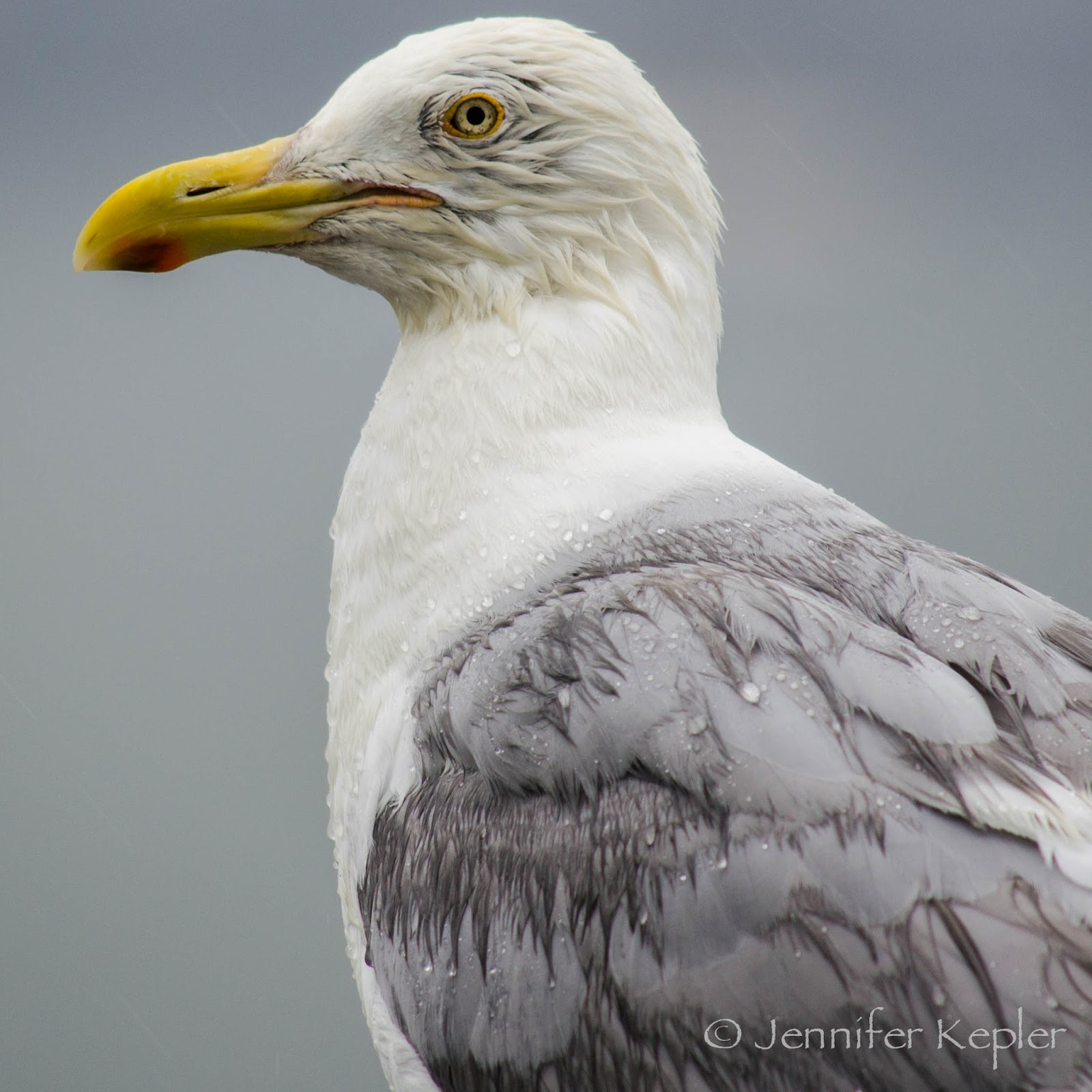
A wet herring gull, looking like he is having the best day ever! Or he is making the "ugh, tourists!" face. 
This herring gull was not so shy and seemed to "talk" to us. Making funny little sounds, most possibly just simply concerned with the mammalian bipeds who were staring him down.
Making on of his odd sounds, if a gull could mumble, that's how I would compare this call to their regular gull calls.

Thank goodness for an pil or preening gland. This gull doesn't look like a wet rag because by using his bill to spread that oil over his feathers, it helps him stay waterproof. Unfortunately the head is the hard to reach spot with your bill, so it seem like he "missed a spot," or his whole face.
I still think he's pretty adorable.
The old coastguard piers are no longer in use, by humans - but they are in use by birds. They are now protected nesting areas for the common tern colony. Here a chick greets it's parent- if you can call it that. It's more like mom/dad hasn't yet gotten in the house and the kids are asking for 20 things...
A little vocalizing after feeding has occurred. The other chick clearly does not belong to this adult, or it is the less dominant chick if it does belong to this adult.
And off to find more food, and off are we to get back to Brooklyn!

Sunday, July 31, 2016

Back to Golden and Hummingbirds

    We drove back many a windy switch back roads to Golden, which I know one of our friends could have very much done without. But the payoff was amazing views, delicious pit stops, a few critters, and ultimately a shower, washing machne/dryer, and bed!
     We drove through Loveland Pass, on the continental divide, stopped in Georgetown for a place to use the restrooms and eat lunch, drove over the Mountain where Buffalo Bill is buried and then arrived back in Golden.  
We stopped in Georgetown, Colorado for a break in driving- picked up a delicious lunch (veggie burger with cheese, onion rings and BBQ sauce? Yes, please!). I noticed signs for a bighorn sheep viewing area, so I asked if we could make a quick stop. At first, all I found was a loud golden mantled ground squirrel, making a loud, repetitive chirp. The difference between these guys and a chipmunk, is that unlike a chipmunk, this squirrel lacks stripes on its face. But both are rodents and closely related.
But then... (no pun intended)
This is the original photo, zoomed in at 300mm, I was able to spot one bighorn sheep. The viewing area does not by any means guarantee a viewing or a close one at that! The image above this one is severely cropped from this photo. The bighorns are doing as they do-- roaming the mountainside, often high up, with their brown hide allowing them o blend in well to their surroundings.
The "best" photo of this guy. He was so far off from where we stood, but I was very glad to add him to my "30th year species list."
We arrived back to Golden, finding that a wildfire broke out on top of the mountain near where we were staying. We learned this area of the mountain is closed to the public, but lightning strikes are common and can easily start a fire, especially in dry grasses and shrubs.
A lesser goldfinch really knows how to choose a picturesque pose. In reality, these birds love flowers that come to seed, sunflowers, thistle, and similar are favorites. It is recommended if you are a gardener (and a lover of our avian friends), not to clip old flowers- let them be and attract in birds. So even without petals, these flowers can still have a lovely element of beauty, adorned with little yellow birds in place of yellow petals!
And now a lot of hummingbird pictures... (sorry, not sorry)
Who is not enchanted by these amazing creatures?! They were so plentiful in the yard of my Aunt and Uncle's home and I was obsessed. They buzzed, did amazing aerial feats, scuffled on the wing, often making perilous dives that you gasped for their little lives, they were amazing. This is a male broad-tailed hummingbird, back-lit, he seems a bit drab, but add a little light and...
That fuchsia throat comes to life! These guys would perch often in a small oak tree they had adjacent to their feeder and among favorite flowers. When perched, they don't walk, they can't walk- their legs are too weak and small, so hovering and their little flighted moves are advantageous to compensate for that. 
But, they can use their feet to preen and scratch that hard-to-reach itch. Seriously, how adorable is this?!
A common wood nymph, there were TONS of these guys everywhere. Actually, in general, butterflies were super abundant, especially tiger swallowtails. Butterflies were going nuts over thistles and any other flowers that on a singular bush or shrub there would be easily over 10 butterflies at a time. 
Oh yeas, back to hummingbirds-- this is the female broad tailed humming bird. Is she sticking her tongue out at me? Perhaps, she did just finish feeding at the feeder though. Hummingbirds, equipped with that long beak, and a tongue that helps them drink nectar similar to how we use a straw. It is something that I can't explain, so here is an article that does, if you are into the nitty-gritty science. What an amazing little package of bird the hummingbird is!
Even the female, while modest, is beautiful in her own right. Her back is still iridescent green. She is a master builder though, creating nests that belong inside a fairytale story, using moss, spider silk, and natural fibers to make the cutest, daintiest cup for her and her young. I had the pleasure of finding a hummingbird nest once, it's a very special thing to witness.
This little thing only weighs between 3-4grams, that is less than one ounce. And this little bird has a skeleton, organs, a little tiny brain, and covered in feathers- I mean if that doesn't astound you, than I don't know what would! Amazing, that this is a little vertebrate animal!
A female black-chinned hummingbird, getting nectar from some of the plants growing in the garden. She unlike the broad tailed has some spotting on the throat and a little rufous coloring on her flanks.
The same bird from above, amazing how different they can appear as they shift in the available light. These little birds can flap their wings about 70 or more times per second! And their flap is not a simple up-and-down motion, but resembles a figure-8 motion.
Black chinned female at the feeder. Our uncle makes a nice batch of nectar up for the hummingbirds, but the finches also like to steal a sip every so often.
Our evening culminated with a downpour that resulted in an amazing full-arc rainbow. Too lazy to change my lens, I get one end of the rainbow!
     What an amazing trip, I am so thankful to have an amazing family, so very welcoming. They are so kind to share their home and their landscape with us. I loved our trip to Colorado, it was such a great time away, although- not going to lie, we were starting to miss home and all our critters here. A special thank you to our family out in Colorado, we love you so much!