Saturday, October 22, 2016

Braving the Weather for a Good Find

     I got no sleep last night, all I heard was the pouring rain. And all I could think about was whether or not the bird walk would happen today that I signed up for at Floyd Bennett Field. After waking up early, skipping coffee, and checking my email, it appeared that we were still on.
     The winds were gusty, like over 30mph gusty, the air was cold, and the rain made things soggy. My rain gear kept me dry, but the cold was really not something I was enjoying.
     While I was being whimpy in my head, the tiny birds were toughing it out. From small field sparrows to some late osprey, they were out there. The smaller birds staying out of the wind, but a few could be spotted on the wing.
     One of the pluses of FBF is that you can bird from the car, which we did, scanning fields, groups of birds and driving to sites. We scanned a group of gulls we saw earlier and I noticed a small egret with them, hunkering down from the wind...
One of these birds is not like the other ones...
A small egret, stocky, shorter bill than a snowy egret-- a cattle egret.
Our leader, Rob was jokingly mentioning prior to this sighting how maybe we'd see a cattle egret as we walked past the farm that they seasonally set up next to the Aviator complex. With cattle present, why not? I don't think we actually expected to run into a cattle egret!
Cattle egret are small, and here he/she is dwarfed by herring gulls who were resting/preening on this grassy field, next to the community garden area.

I think we've been spotted.
But being little, I would assume you need to be rather aware of anything above you, bigger than you.
Despite the wind, cold, and rain- this made the trip worthwhile. Glad I was able to get out and spy this little egret with the group!

Friday, October 21, 2016

Bike Path Wildlife

     On my bike ride home from work, I opt for a longer and more scenic ride home along the path that takes you along Caesar's Bay and the Belt Parkway, under the Verrazano Bridge, and up into Bay Ridge. It is 5 miles longer than my usual ride up Ocean Parkway, but the views make up for the extra milage.
     Often I am hoping to spy a spouting whale, or a different gull from the standard species found along the way. Often I am dodging the lines of casting anglers as the fish are plentiful along the span of the path. I saw two anglers pull up a flopping catch as I approached them and I had to stop, because it wasn't any ordinary fish, it was cartilaginous, flat, and one we often see evidence of on the beach...
The bottom of the animal -- I know it's a female as it lacks "claspers," specialized structures on the pelvic fins that help males mate and internally fertilize the female. Sharks and their kin don't spawn, they are more sophisticated than that, even though their kind have been on this planet for 400 million years.
This fish is a skate, I think it is a little skate, which are more common inshore. Skates like sharks do not have bones, but skeletons of cartilage. They are not sting rays-- but related. Skates have fleshy fins on their tail, not a stinger. But they are related to sharks, and like sharks have some crazy rough skin that looks rather toothy, because they are dermal denticles. I touched it and got the chance to feel how rough she was.
I asked the anglers if they were planning to eat it. And they looked at me like I asked the craziest question. They asked me if I ever ate one, and I told them I did, and that I stopped consuming skate because they are not really good to eat, sustainably speaking. They told me that when they catch these guys they always toss them back as they are of no use to them.
To learn more about sustainable seafood, check out the seafood watch guides from Monterey Bay Aquarium.
And in case you were wondering, this is the evidence of skates that we find on the beach. Playfully referred to as "mermaid's purses," these are egg cases that once contained and protected most usually a single embryo. The washed up cases are almost always empty, the baby skate once developed makes its way out and into the ocean world.
Egg cases can be identified by species, based on characteristics, allowing researchers to know species present locally and have some idea of their population densities.

Sunday, October 16, 2016

Marine Park Salt Marsh 10.16.16

     After taking yesterday to be all domestic and wife-like (I made batches of "Sunday Sauce," apple muffins, cleaned the place, went dress shopping, and made a killer bowl of miso ramen- with all the toppings... no, I'm not bragging....), today had to be an outside day. And what a day it was, I got to shed a few layers!
     I made an afternoon of things at the Salt Marsh Nature Center in Marine Park where I spent a lot of time watching everything. I checked out every sparrow, sat around hoping things that dove in for cover would come back out, and muttered out loud, often, to myself "ugh, another song sparrow..." or "...yellow-rumped."
     I got some nice surprises, in terms of observing behaviors, and some photogenic individuals. So no complaints in terms of todays sights, enjoy...
I arrived with high tide, and a group of 4 double-crested cormorants were fishing together. I would assume that working together around a school of small fish would work out in someones favor. They would dive and resurface together. I saw them come up a few times with a prize.
A snowy egret, perhaps thinking about the journey that lies ahead and perhaps considering waiting a few more days as temperatures here are predicted to get up to 80 by mid-week. 
A very urban look for the song sparrow, as it poses so perfectly on a chain-link fence. Someone once mentioned to me how it seems that chain-link was designed with birds in mind, so many of them has no problem navigating through the small space between each link.

Hard at work.
A female downy woodpecker makes the perfect little cavity. There are a few dead trees in the salt marsh, often dead trees are removed by humans- thought to be of little use, or simply an eyesore. But dead limbs and trunks provide great opportunities for cavity nesters, and ones that create those cavities.
I was told by another observer that she has been working at this for the last two days.
A back trail, toward the ball courts are perfect for peeking at sparrows and finches. The tall grasses are full of seed and the seed-eaters are taking advantage. Here a swamp sparrow forages close to the edge.
Many American Goldfinch were bobbing and swaying from the stalks of the tall wildflowers.
I really wanted this to be something else, but who knew- the swamp is full of swamp sparrows!
Lots of bee species taking advantage of the goldenrod. Also taking advantage of these late blooms were monarchs and cabbage whites.
I also heard a call I know well, only to look up and find a pair of kestrels scanning and hovering for prey. Here, is the male.
I saw the pair had settled- I found the female on one tree eating her prize. Being the smallest falcon in N. America, it is not uncommon for these birds to prey not only upon small birds and rodents, but insects too. It almost looks like she has a mantid or katydid.
And then she made for a wonderful subject... note how her belly is streaky, kestrels are easy to tell apart in terms of their sex.
Another indicator of sex- the wings, barred on the female, wings of the male are slate blue.
Both male and female are some of the more beautiful of the birds of prey. I admire them greatly, tiny but tough.
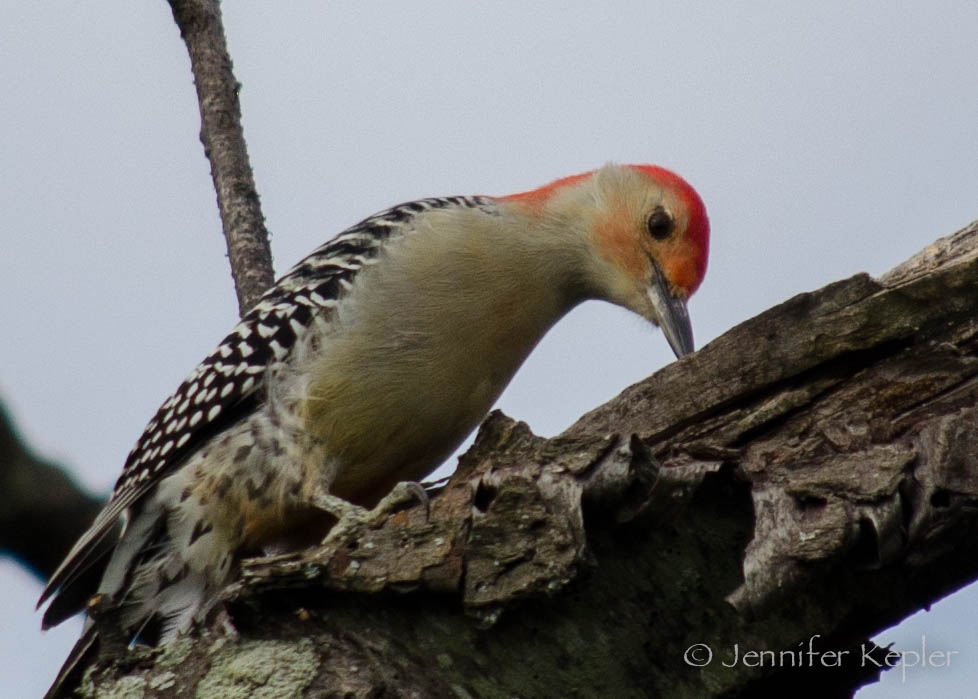
A red bellied woodpecker peers around a dead limb to see if there is anything worthwhile...
He didn't give a single hammer- he just peered around...
Frome all angles, just to make sure he wouldn't miss a morsel.
Lucky for me, the male kestrel was just a few trees over from the female. A handsome guy, he is.

How perfect is this avian-dinosaur?!
Perfect!
Also treated to a coopers hawk who scared the sparrows I was watching. I tend to enjoy the raptors over the little guys... they really draw me in.
By time I left, the tide had gone out and the low-tide crew came in- more egrets and a group of greater yellowlegs, ran around chasing down little things to eat.

Friday, October 14, 2016

Hook Mountain Hawk Watch

     I was really happy to work last weekend- during all that crummy weather, to earn a day off during the week. Weekdays are my favorite time to treat myself to the outdoors, because everyone is at work and it is only that much more quiet!
     I have made a trip to Hook Mountain in Nyack, NY an annual outing over the last 2 years. I have throughly enjoyed not only the birds but the people I meet and get to know in the hours spent at the summit. I saw some familiar faces, that I remembered from my last visits and outings like these are where birding can be a a social event. We do a lot of discussing about birds, wildlife, nature, and our own lives.
     With clear skies today was challenging, and my wind burnt face reminds me of how I should have had another layer on, but I still had a really great time and I think the photos will support that. Enjoy the sights!
Following the yellow trail, I made my way up to the top of the hook from Rt 9W. It is a steep climb, but fairly quick, if you have the stamina.
We were counting migratory raptors. Local birds, residents, did not count. So redtails were constant distractions, there were 4 individuals hovering and hunting over the side of the mountain. The juvenile birds were extra curious and brave.
With winds in their favor, the red tails didn't even have to flap, enabling them to soar in place, allowing them to scout the landscape for food and foes. The juvenile birds are easy to tell apart from the adults, they still have banded tails, instead of the rusty red colored tails of the adults.
They looked at us a lot too.
Who is watching who? While I have to zoom and crop these images to see their faces clearly, they can just do that with their eyes from where they were in the air.
A smooth sailing bird, in place just peering at Rockland Lake Park below.
And we tried to count other things.... like Cooper's (shown) and Sharp-Shinned Hawks.
View of Cooper's (from above) again.
And more of these little trouble makers...
A cropped image of the head-on view shown below.
They flew in very close range to us, sometimes just past our heads- mostly aiming for the dummy owl, propped up to draw raptors towards the mountain. The red tails at one point actually hit the owl with their feet, making a thud that spun the owl around on the stick it sits up on. 
Their close range also made for good photo opportunities.
If we were lucky we could have views like this- a sharp-shinned hawk. The solid blue sky makes spotting hard, and that phrase "out of the blue," I really think this is where it came from. Without any contrast some birds barely appeared, just as the flew past us, I am sure we missed many. 
A large migrating group of brant flew past, a very cool sight!
Turkey and black vultures were common all around the mountain, but often in their kettles we spied other birds, like osprey, red-shouldered hawks, bald eagles, and accipitors.