Wednesday, December 21, 2016

Bronx Zoo: A Rusty Birding Adventure

     Today for work I had to report to the Bronx Zoo. I headed up earlier than I planned to, specifically to do some birding before beginning my work day. The zoo has a wonderful natural area along the Bronx River, the Mitsubishi Riverwalk and just in there I got 20+ species in just a short period of time. The highlight of my walk were many rusty blackbirds and a feasting red shouldered hawk.
     I sure hope people read this quick little blurb-- if you're squeamish, I warn you I took a lot of pictures of the dining hawk, and yup- there are guts from a mouse involved. I find it fascinating, but if you find such things icky, you may consider speeding past those pictures (They come right after the wood ducks).
     Anyway, enjoy!
Spotted a mix of male and female wood ducks, 5 birds total on the river.
They are just so stunning, I can't help but always try to grab photos of them!
At first, not going to lie, this hawk confused me- with its legs so exposed, hunched over its kill, it looked like a Cooper's hawk. But my instinct was to call this a red tail. The posture really transformed the way this bird appeared to me, in the end this is neither! Good call by my friend, Jeffrey- this is a buteo- like a red tail, but it is a red shouldered hawk (immature). 

Looks like this guy nabbed a mouse. Raptors are excellent for rodent control, but their greatness to controlling rodents is also their demise-- as we control rodents with poisons and chemicals, these toxins are passed onto the predators who accumulate these toxins and can feel their effects- most often resulting in death. 
This hunched posture is in attempt to cover their kill, and a check of the skies above to make sure no one else has eyes on his prize.
Sharp talons as forks, and a beak, hooked and knifelike, this hawk utilizes its best raptor table manners for its meal.
This hawk has a leg up on the day with this morning meal (see what I did there?).
And now for the final GULP!
And down it goes!

Admitting my mistake- edited- this is a red-shouldered hawk! 
Smile :)
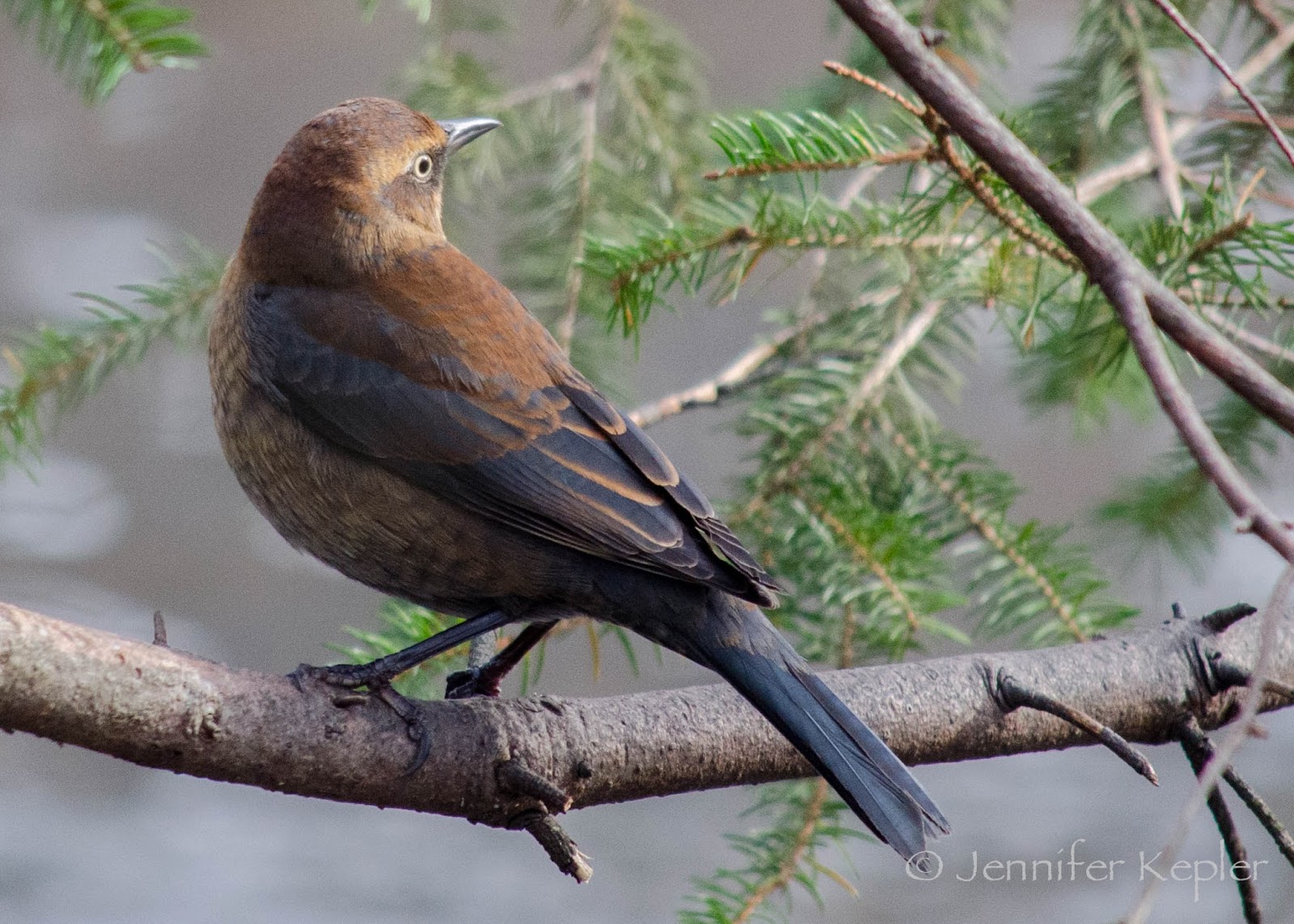
One of quite a few Rusty blackbirds on the Riverwalk!
A belted kingfisher, calling, excessively over the open water.
An adult Cooper's Hawk high in the trees, eyeing the red tail from earlier.
AND MORE RUSTY BLACKBIRDS! These guys were in one of the exhibits- the Northern Ponds, where waterfowl (some local species) are exhibited. They are so close and utilizing the muddy shorelines.
Why are rusty's so exciting to see? Of any migratory bird in North America, they have experienced the most rapid decline (80-95% since the mid 1900's). These birds love wet areas in woodlands. The zoo pretty much has that naturally (along the Riverwalk) and within exhibits that have "natural" pond water feature. The places where they nest and breed though have gone through much decline, and of course is all linked to human influences. A bunch more info on these very unassuming birds can be found here: http://rustyblackbird.org/


They are beautiful little things, and normally very shy, so what a privilege it was to see them so close!


Tuesday, December 20, 2016

It's Been a While...

     With holidays in full swing and so many commitments, birding has not been something I have had at the top of my priority list. Baking, family, work, and gifting has taken over my world, it just never feels like there is enough time in the day!
     But last weekend I got to go on the Christmas Bird Count for Kings County, a soggy, cold one at that. Pictures are lacking due to the weather-- and we had a film crew from HBO'sVICE news, so that was interesting too. But I was able to go to Floyd Bennett Field and the beaches around Coney Island in just the last few days, so here is a little bit of my pre-work adventures from Monday at Floyd Bennett Field and today in Coney Island. Enjoy!
A very cold and unproductive morning at Floyd Bennett Field got me a dozen of these cuties, some tree swallows... on ice.

Checked out some of the gulls on Coney Island Beach this morning before work. Most were ring-billed gulls, like this guy.
A juvenile greater black-backed gull picks at the typical "food" to be found on the beach, trash and debris.
Marine debris are a huge issue, birds, fish, and other species consume this trash- either ending in their death or working its way up the food chain-- enjoy seafood much?
A young herring gull with a plastic piece.

A nice surprise, (two of) a trio of black skimmers!
Pretty stoked to report this banded skimmer... I can't wait to learn more about it! If you find a banded bird- report it! https://www.pwrc.usgs.gov/BBL/bblretrv/


They are pretty funny little birds...
...especially with that asymmetrical bill!

At first I thought this gull had a fish... nope, just a chicken foot.

Guess this guy is gonna have a great day.

Sunday, December 4, 2016

Bike, Brunch, Bird.

     I met up with some of my wonderful girlfriends for brunch on the Upper West Side this late morning. I decided I would earn my brunch by biking the 12.7 miles there from my home in Brooklyn. It was a perfect day for a ride and wonderful to see my friends. We had a great meal and a cappuccino was perfect to energize me for the ride back.
     Now I do things strategically. I knew I'd have to pass through City Hall Park, exactly where a Western Tanager has been hanging out, plus some bonus (very) late warblers. So instead of taking the train and having to use up swipes, the bike is free, faster, and I can make a pitstop on the way home to tick this one off on my life list.
     Well, needless to say, mission accomplished:
Photos are subpar, but enough to tell the story. Here is my first look at the Western Tanager!

Also spotted, a [pair of red tail hawks, causing a ruckus among the local pigeons.

My favorite part about going to find birds in a peculiar place is the other peculiar and interesting sights you might never notice, like this hair piece on Lady Justice atop City Hall.

A male American kestrel finds this to be a fine perch.


One of the three bonus warblers, a male black-throated blue! I also spotted the common yellowthroat, but missed the ovenbird. It is super amazing that all this was in a patch of shrubs with a few trees growing out between them, between the courthouse and city hall. I am always super amazed at how in such an urban setting, this small little patch of green provides habitat.
I was watching this tanager as it hung out close to a yellow-bellied sapsucker and thought to myself, I have seen so many birds in conjunction with sapsuckers, a yellow-throated warbler, a Couches Kingbird... and this tanager (as well as the yellow-throat that one time) was feeding among the wells drilled by the sapsucker. These wells "bleed" sap as well as exposes and attracts insects and the sapsucker meticulously drills a series of these wells and feeds from them-- but others feed from them too. In my mind I was wondering if sapsuckers would be considered a keystone species, helping to support others in their community. Well upon investigation, it felt really great to find that my observations and my hypothesis are supported by other sources:
http://www.arkive.org/yellow-bellied-sapsucker/sphyrapicus-varius/
http://www.bbg.org/news/birds_of_brooklyn_yellow_bellied_sapsucker
http://www.borealbirds.org/bird/yellow-bellied-sapsucker

Why is this bird so exciting to see? Well, they don't really come to the east coast. Their range is from the plains and west to the Pacific Coast. Also, by now, this bird should be in Southern Mexico to Central America. You can check out their natural history on their Cornell "All About Birds" page: https://www.allaboutbirds.org/guide/Western_Tanager/id
This bird was not easy to see, it's up high and often on the back sides of thick limbs. Oh yeah, and it's a yellow bird in a tree that is holding onto a few yellow leaves. You really have to crane your neck to see this one.

Also, passerby's -- which there are a lot of in this part of town are all sorts of like "what the hell are you looking at?!"
I'm glad I stopped to catch a sight of this bird on my way home, if you're planning a trip to see her, between this park and Trinity Church just a few blocks south, you can grab 5 rare birds (either out of range or season) in a visit, because the Yellow-breasted Chat is still there (and is apparently a dumpster diver). 
So don't just think NYC's most urban green spaces are just for pigeons, if you look a bit longer, you might discover someone new!


Saturday, December 3, 2016

December Walk in Prospect Park

     With the sun shining and mild temperatures I headed to Prospect for a long walk. I just got my binoculars back from Nikon this past week- they fixed the eye cups and cleaned them and they are like brand new. I was very excited to have them back and use them.
     I am also excited to have my binoculars back in time for the Christmas Bird Count in 2 weeks. I look forward to this annual event and enjoy the team leader I continue to join for this walk. This will be my 3rd year participating in the count. Here is more information on the count and how you can participate: http://brooklynbirdclub.org/trips.htm
     I saw a total of 33 species today including one I was hoping to see, enjoy the sights!
Heard some singing in the phrags when I first arrived at the lake. I knew it wasn't the house sparrows or red-wing blackbirds... then this guys popped out. A non-native European Goldfinch. My husband asks, "Why is that a goldfinch? It's not very gold." It has yellow on its wings- I suppose the American Goldfinch has a better suiting gold in their finch.
Sweet gum trees are filled with (both) goldfinches, red-winged blackbirds, and lots more chickadees.
A European goldfinch takes advantage of the bounty.
This male cardinal in the midwood area was feasting on fallen seeds (note the crumbs around his beak).
...And he sat for photos.
I was hoping to find one, my first of the season fox sparrow! I love their rusty brown color, their chunky size, they are just very beautiful birds.
A melanistic squirrel on the Neathermead fattening up for the cold.
Cute mouth and paw action!!
A nice find, one of a pair of pied-billed grebes.
So cute in that afternoon sun!
Most of the N. Shovelers were in huge feeding groups, I love watching them swirl!
A drake shoveler looks pretty sweet in his breeding plumage. Winter is best time to catch ducks looking good. While song birds are not in breeding plumage, ducks are looking spiffy.
Canada Geese coming in for a landing, a funny, clumsy-looking landing.