Tuesday, September 4, 2018

And Fall.

     Most people feel Labor Day marks the end of summer, but for birders, fall begins in August. Many of our beloved birds are done with their summer residence and are moving south and this is a hot time for shorebirds. Normally at this time, one can walk quite comfortably around the south end of the East Pond at Jamaica Bay WR, but we had an exceptionally rainy summer- higher totals than normal. So the pond is a bit more submerged and one needed at least calf-height boots to traverse. It was a little scary, after my last ordeal with quick sand/peat, I didn't want my day to end with me submerged thigh high in muck. If you go, hug the phragmites and then do a good tick check - thankfully I only had another arachnid all over me, some really cool, streaky looking jumping spiders (I like spiders, so this is no problem for me- but be warned).
So many lesser yellowlegs, as mentioned in the post before the one, they are the bester yellowlegs.

Short-billed dowitcher- a few of these in the mix among the peeps.

A greater yellowlegs with a tasty treat- looks like a small fish?

Yum!

A lesser yellowlegs acting like a phalarope.
Note how much shorter and finer a bill it has from the greater yellowlegs above.

Feel pretty good calling these white-rumped sandpipers- wings extend beyond the tail- they are longer than the semipalms and base of bill is lighter.

Here is the white-rump with a semipalmated (in front) - you can see the base bill color difference and you can see in the semipalm, the tail and wing tips are equal in length. The back bird is also longer and larger than the semipalmated.

oh and there is one more way to ID the white rump...

...their namesake.

I took a lot of pictures in the field, so I can better study them with a field guide in hand- because man, there is so much variation from bird to bird it can cause you to second guess yourself.
So, white-rumped compared to...

Semipalmated sandpiper--- right off the bat, the wing lengths are different between the two birds.

Even with their heads underwater- you can tell when you don't have a semipalmated sandpiper.

Not a semipalmated sandpiper.
(this is the other end of the same bird above - a white-rumped sandpiper)

When you hear this loud wooshing and splashing- you just want to make sure it's not heading in your direction. For this mute swan, part of a family of 6, it just needed to move a distance fast, so it did some water "walking" that comes with loud flapping.


Without waterproof feathers- I would assume drying was quite easy today for these double-crested cormorants, as temperatures soared.

It's so hot, even the osprey are panting!

At least this bird scored a bunker for lunch.

This bird seemed different- I admit, I could not ID this bird in the field, so I snapped some photos and grabbed my Crossley Shore Bird Guide.

Upon studying and thumbing through pages, this is a Western Sandpiper.
The long legs, the uniformly dark bill, the overall size compared to a semipalmated that was in the foreground tipped me off in the field that this one was not like the other ones.

A crappy photo, but I promise, in real life, blue winged teals are damn stunning! And why did they all take flight?

This trouble maker. I think this juvenile peregrine falcon was just having fun stirring up the locals. It flew low and swooped over groups of birds, just being its fast, powerful, flying self.

I just imagine this bird is flying to "Enter Sandman," on repeat, as it wreaks havoc and hunts unsuspecting prey.

bad ass.

This monarch must have been hungry- because it barely as much as flinched as I walked by.

One of many great egrets on the pond- I love egret flybys.

And the lesser (bester) yellowlegs snags a yummy wormy snack! 

Puddle Birding

     Who knew puddles could be such great places to bird. For two days at the end of August I birded the puddles at Floyd Bennett Field, hoping to find a Baird's Sandpiper (I didn't) but found an array of other birds. While disappointed that I did not see the Baird's, the ones that I did see were still pretty great. In living now so close to FBF, I will need to start doing this more and learning that area better. While I attempted to walk the North 40, the mosquitoes kept me out. So for now, it's fields and puddles.
One morning all I found was a solo lesser yellowlegs, or better known as the bester yellowlegs. Against the great yellowlegs, this one wins, for the cuteness factor alone. 

D'awww!

This is a puddle in front of Aviator Sports. Busses towered over this puddle from dropping of football teams taking practice on the fields. While I cannot imagine these puddles have the cleanest of water (from the car oil, debris, and who knows what). I bet they are full of larvae because a standing pool of water is high value for insects. And larvae are high value to wading birds.

A check of the same puddle after work, on the same day brought a different crowd, mainly a group of killdeer- who were clearly having a crazy kegger.

Killdeer always have a look of worry in their eyes- mostly due to that white eyebrow-- but it serves them well, because if you do so much as make eye contact with a killdeer it takes flight making it loud call, screaming to let the world know how it narrowly escaped its death.

But on this 90+ degree day, I watched from my car, which oddly makes for a good blind-- and oddly, is more likely to kill a killdeer than me standing with binoculars around my neck.

I visited a second (shrinking) puddle across from the community gardens where I could not use a car for a blind and made eye contact with a killdeer.

This puddle had mostly semipalmated sandpipers that I wanted to so badly to be something else.

A least sandpiper, also scampered through the grasses and along the puddle edge, with the semipalms.

And a savannah sparrow even joined the crew.

Two days later, the puddles were empty and nearly gone, but I had a great time watching this house wren fledgling.

How cute is this little nugget?! Still growing in those feathers! 
This little one made a heck of a racket, which makes for a stereotypical nosey Brooklyn Neighbor scene- the whole wren family came out to take a look but so did the common yellowthroats, which this bird proceeded to chase out of "its shrub."


And scream.

I love wrens, they have bravery as big as their voice, packaged up in that little birdie body.

Saturday, August 18, 2018

Marbled Godwit

     I like big birds and I cannot lie, you other birders can't deny... when marbled godwit ends up on the tip of Breezy Point, just a quick bike ride away, you don't dip out!
     While ripping off a Sir Mix A Lot song may not be my thing, I really do like me some big birds. Don't get me wrong, I love little warblers, gnatcachers, and swallows-- but I also love and take great joy in observing large raptors, a large shorebird, or a duck. My definition of a big bird is anything larger than a thrush, and part of the reason I may take a favoring to them is because you can look at them without binoculars and watch them even more so interact with their environment-- you are not limited to just the field in your binoculars.
     So, when a Marbled Godwit - this falls into the larger shorebird category for myself - is on a local beach and has been hanging steady, a life bird, accessible by bike-- you go get it! Off to Breezy Point I went...
Not a bird, but happy to see so many Monarchs in the air... this one is on Poison Ivy.

Lots of rain means lots of puddles-- it has been a rainer than normal summer and these puddles attract birds. These puddle birds, in the 4-wheel drive lot on the beach, are lesser yellowlegs.

With the Lesser Yellowlegs was also this solitary sandpiper, a nice surprise!

Okay, small bird exception-- although- they are not that small-- I love terns. A common tern prepares for a good...

...long stretch of the wings. Those wings best be ready for a long flight down toward Brazil and Argentina for the winter!

Smile!

Don't they look like little hustling commuters, trying to get to work on time? A ruddy turnstone, left and a semipalmated plover, right.

Go little turnstone, go!

I liked this juvenile laughing gull in its soft brown tones.

Ever wonder how a bird gets water proof feathers? The preen gland or uropygial gland is how! A waxy oil is collected by surrounding feathers that the beak is then rubbed over to then spread to other feathers.

Target bird-- a marbled godwit that thinks it is an American Oystercatcher.
That beautiful, upturned, thin bill, tall on twiggy legs, I was so stoked to see this bird in person!

This bird is either non-breeding or immature as indicated by its plumage and bill color.
Many folks think of Spring and Fall as migration times ... truly many birds get their migration south starting in August as they have bred in late may through June, with their young grown- it's time to head to their wintering grounds. This bird migrates and breeds in the grasslands and into Canada, on the side just East of the Rockies. They generally don't hang in NY, but this one perhaps got off track a bit- it's winter destination is the Southeastern Coasts of the United states and/or the coasts of Mexico and Central America.

A semipalmated plover taking a rest in the sand- saw 3 plovers on the beach yesterday, semipalmated, piping and black-bellied.

A stone-standing, sleepy ruddy turnstone.

 A great black backed gull eating a discarded dogfish.

Worlds largest gull eats the not worlds smallest shark.

More looks at that godwit.

That long bill is for probing, worms, insects, and other invertebrates-- even small fish.

It's also used for precarious preening!

Gorgeous bird- so glad to see it and add it to my life list!

But before we go...

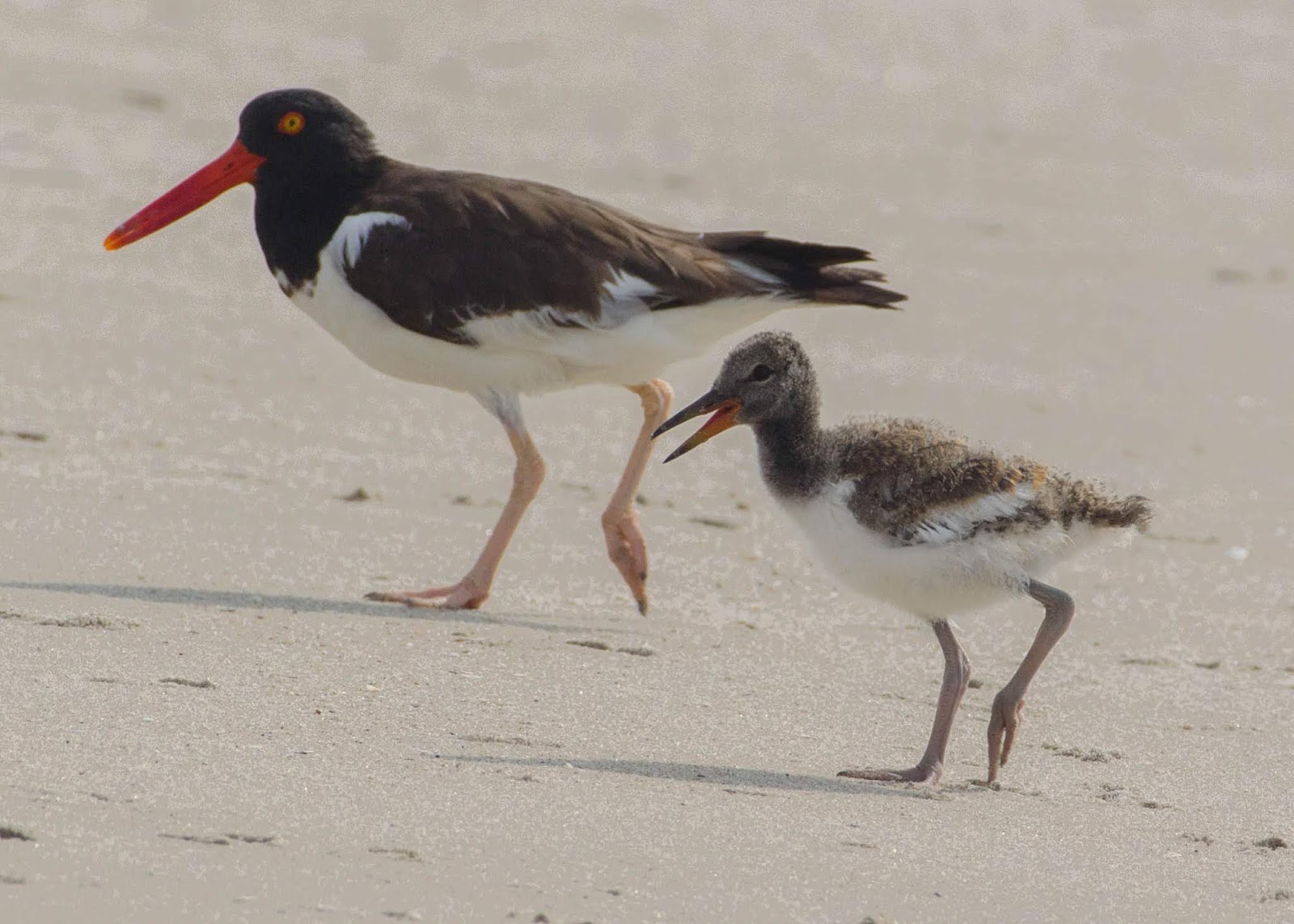
A little tater tot learns the way of the Adult American Oystercatcher.... make as much noise as you possibly can, be loud and proud!