Saturday, October 6, 2018

Global Big Day!

     Today was a global big day. That means it's an all you can bird feast for a full day!

     I birded with a few folks throughout the day but from 7:30am till nearly 5pm, I was able to attain just over 70 species. Within that list, we got the three falcons (American Kestrel, Merlin, and Peregrine), an amazing group of crows that chased and chased a red tail hawk, cooper's, sharp-shinned, and harrier, royal terns, a late least sandpiper, and the last bird of the day was a life bird for me, a dickcissel.
     We raised some money for CVTC in the process, so I am looking forward to what our efforts will reward this organization with!
     The day was overcast, we had to work for birds as much of our views were backlit, up high, and hard to make out. I took very few pictures-- mostly had it on me for if we had anything good or that I needed to prove on an eBird list - glad I had it!
     We birded 3 sites: Prospect Park, Plumb Beach, and Marine Park in Brooklyn.
I kind of expected to see royal terns today at Plumb Beach at low tide. So when I saw 4 in a row, sandwiching a laughing gull, I was pleased.


The coast was the area that best turned up white egrets, both great and snowy. This great egret dreams of being an osprey some day.

"What is that???!"

When strongly backlit, I doubted this as anything spectacular and thought I just had a house sparrow- but its head is so flat.... then, I stepped a few paces to the left, changed the way the light hit this bird and then we realized it had to be something else. Hints of yellow, those fine streaks...My preliminary guesses were bobolink (female/immature) and dickcissel. Definitely not bobolink, upon closer inspection and comparison to guides and google image searches (21st century birding, here). With some encouragement and confirmation from birding friends (thanks Molly & Jeffrey). We felt good confirming this as an immature dickcissel.
A life bird and a great one to end the day on!

I look forward to finding out how much we helped raise for a good cause, and I look forward to see what the compiled eBird lists for the day show for species count world-wide!
I hope folks had an amazing and birdful Big Day today!

Tuesday, October 2, 2018

The 5th Year


     I have a lot to celebrate today and everyday, 5 years ago on this day I went home from work on my bike and that's all I remember.
     I woke up in a hospital bed, I remember my mom and dad and Tim- I think that was it. Memory then was very fuzzy after being doored by someone exiting a car. Don't remember it happening but my body gave me a few mementos to remember the event by: concussion, complete with brain contusions, lung contusions, fractured skull, fractured clavicle, vertigo, and short term memory loss. My memory was so bad I'd travel to appointments with pad and paper if I had to go alone.
     It was a rough 2 solid months of recovery- I sat home with a cat and parrot. It was depressing- being ordered not to work, but not actually sick. A doctor finally cleared me to start going for walks- actually he recommended it, to build my confidence and short little walks to see how I felt. I'll never forget my first birding walk, the birds, the nature was so therapeutic. Nature and the outdoors heals me- it calms me, focuses me, I get some exercise, and I happen to love the creatures that occupy the outdoors.
     So, I celebrated today. I had just enough time before the sun set to walk around by myself in the salt marsh and enjoy that I still get to live, savor the sights, and experience what life throws my way.
As the tide dropped it invited more and more leggy birds to come feed. A blue heron holds onto a spot it likes. Later black-crowned night herons, yellow-crowned night herons, and greater yellowlegs noisily joined this bird.

This is a female mantis and she is GRAVID! Her fat abdomen is full of eggs. This fall she will leave behind an ootheca, a case that will contain her eggs and over winter attached to a twig or woody reed. She will die with the oncoming cold, but if her ootheca makes it through winter- without becoming a high protein survival snack for a bird-- her babies will emerge in the warm season that follows.
She is a gorgeous creature, I'm in love with mantis'.

Goldenrod- a lifesaver for migrating nectar eaters. Goldenrod blooms into fall and is a lifeline for monarchs, bees, and others. The goldenrod was also amazingly fragrant, and that combined with the smell of salt in the air was perfection.

The most wonderful thing was watching the monarchs carefully select a roost for the night. In the dropping temperatures, the monarchs must rest, they are solar powered and in the night there is much danger. Monarchs find a nice tree and gather overnight for safety. This was one of two, perched together, inches apart.
When they overwinter in Mexico, their roosts are amazing and massive, a natural wonder of its own.
I spied this little corn snake in a tank in the nature center. What a cute little noodle! Reminded me of my late Jake. 


A perfect evening walk to remind myself how fortunate we are to experience the natural world around us.
AND- this Saturday 10/6/18- I am participating in a Global Big Day birding outing with friends- and via the Feminist Bird Club- we are raising money for CVTC- to support victims of domestic and sexual abuse. Please consider supporting us by visiting our donation page, here!
Wish us luck!

Sunday, September 30, 2018

Wildlife in South Florida

     The final destination in our Florida Trip was Miami. We stayed in Coral Gables which has a park that's part of the Great Florida Birding Trail, but our sights were on the Everglades. Over three days, we checked out 3 different places: Everglades National Park, Key Largo, and Biscayne Key.
     We might be the few people who visit Miami and barely hang out in the city itself. As for Miami proper and learning about the city, I recommend HistoryMiami, a museum all about Miami, past and present. They have a really cool Miami Street Tradition Exhibit that I enjoyed and a comprehensive permanent collection that takes you back to Miami when it had direwolves living there to the Native Peoples who settled here before Europe arrived through present.
      We visited South Beach by night... on a weekday, if you like restaurants hawking at you to come eat there, I guess that's fun. To be fair it was also September, it's a lull in Tourist season. I also bought Tim some tickets to see Jerry Seinfeld at the Performing Arts Center. That venue was fairly impressive. A hop over to the Winwood neighborhood made us feel like we were in a gentrifying Brooklyn neighborhood as it seemed to be up and coming and held the local population of hipsters. The buildings all have eye-catching graffiti and there is a whole set of walls that invite artists to create a graffiti installment. That was a lot of fun, looked like a place to do some serious instagramming, as most were.
     But anyway- enough with my very few Miami recommendations- onto the wildlife:
Some mating Eastern lubber grasshoppers.
These are massive grasshoppers and notorious pets that can be hard to control. I'm glad I didn't try to pet them, because when disturbed and distressed they can expel a noxious spray and smell through their spiracles.
You can find these grasshopper on blades of grass, clinging tight and eating.

On the Anhinga Trail, this gator was resting on land, drectly below us, standing on the boardwalk.

Saw lots of snakes, anoles, and tadpoles on the Gumbo Limbo Tree Trail.

At the Royal Palms Center, right outside the bathroom, a crowd gathered. Mom and her Brood!
These babies were so fresh and tiny.

These babies even gave a few chirps, to contact their mother, and stay together. Just FYI, baby gator chirps melt my heart, to the max.

My guess is that mom takes her babies close to the center. People are near it keeps predators away. The area they were sitting was in a thicket, probably to avoid the sun. But herons would devour these babies, no problem, if given the chance. Seems they had a good spot.

Loggerhead shrikes were easy to spot, while driving. Takes a perch up on signs, the car acts as a perfect blind. These birds always seemed super shy, so stay in your car if you see one and put on your flashers and enjoy a little butcher bird.

We drove all the way down to the Flamingo center, the southernmost part of the park. It had a lot of storm damage from Hurricane Irma nearly a year ago, so it looks a bit worse for wear. The ranger in the center was helpful in that she filled up our water bottle for us with cold fresh water and she told us where to look for manatee and American crocodile. We saw a manatee, but no crocs- the heat of the day even gets too intense for reptiles who seek shady cover. I think that was the case for when we arrived there.
But upon arriving and parking turkey vulture, waddled like turkey across the lawns and cattle egrets perused the freshly mowed grass. This young turkey vulture was about as cute as they come.

Presuming the bird it was associating with was a parent. A mature bird with that characteristic pink turkey head that gives them their name, I personally have a big adoration for vultures and their ecological role.

White ibises (pictured) and little common ground doves also hung out on the lawns surrounding the Flamingo Center and parking lot.

On the recommendation of the ranger at the Flamingo center, we drove down to the Eco Pond before the camping area. Saw a mature bald eagle before the pond, then heard it calling later, while walking the pond.

The Eco Pond was a short walk (and thank goodness it was), about an 1/8 of a mile. It was also covered in biting flies and mosquitoes. But, it did have the only roseate spoonbills of the trip!
The mosquitoes were never bad, if you were in an open area, especially if exposed to wind. But once you had wind breakers like trees, shrubs and thicket-- all bets are off, you turn into some good mammalian eating!

We drive back north from Flamingo, stopping at point of interest along the way to spy what we could. To be honest, the heat and mosquitoes got to us and any trails seemed not super interesting after getting assaulted in the Flamingo area by biting insects. And then the typical afternoon rain rolled though.

My recommendation when leaving the park, stop at Robert is Here, pet an emu, feed some goats, (wash your hands!), and get a delicious fruit milkshake!!! That made all the heat and biting insects worth it! I am so glad, my good friend Amy recommended this to us.

Another trip took us underwater. We visited Key Largo and did some snorkeling at the John Pennekamp Coral Reef State Park. The Park has sandy beaches and reefs just offshore, past the mangroves.
It also has another exotic species- the African Red-headed Agama. We saw a male in his red head and indigo bodied glory, but we also saw some females that resemble baby beaded dragons in their appearance. They look similar because these too are in the agama family with beaded dragons.

I like those blues in her face- remind me of the waters we snorkeled in!
While we didn't pack the underwater camera, now having worked in an aquarium for almost 5 years, I was able to identify many of the fish! 2 Species of parrot fish, Spanish hogfish, doctorfish, porkfish, yellow goatfish, yellowtail snapper, trumpetfish, barracuda, spotted eagle rays, among many others were spotted! The reefs themselves look like they are not doing as well as they should, beyond each little bit of reef is just dead and crumbled corals, bleached and lifeless.

On Key Biscane, which is just a short drive from Miami and has some super fancy real estate has a park on its southernmost end. We walked there, hiked up the light house and walked the beach. We spotted small needlefish in the shallow water. But on land, we spotted these black spiny-tailed iguanas. Some were quite hefty and threw their weight around. Those who were the smallest, minded their business and stayed out of trouble, but those in the middle size range, really liked to push the buttons of the bigger individuals.
On our drive back I spotted a magnificent frigate bird over on the the bridges that connected us to the mainland.
If heat and humidity is your thing- then Florida is your place. In winter many of these places would probably be even more fun to bird, as many use these parts as wintering grounds. If you do go in the heat, water is your friend, but also, so is a salty snack. I have never sweat so much from just turning head to look at something. But Florida is a fun place to bird and observe wildlife, especially if you enjoy going for a swim after!

Thursday, September 27, 2018

Loxahatchee NWR

     Birding on vacation with a non-birder can be challenging, but Tim is very forgiving and humors me by coming along to explore new places. And we both have things that are unique to us, he is training for a marathon so when he goes out to run, I go out to bird. It works really well.
     While Tim prepared for a run in the heavy Florida heat, I drove off to Loxahatchee. A National Wildlife Refuge that is part of the marshes and waterways that connect and flow into the Everglades. Also, it is found along the Great Florida Birding trail, no surprise!
     It is a likely place to find snail kites... I only found the remains of snails, no kites. But if you can, there is a canoe trail to enjoy and probably find more birds and gators. I wish I had a little more time to explore it, but honestly it was so hot and the Everglades awaited our arrival...
Before I even made it in, I did a double take, hit the brakes, snapped into reverse, window down. Hello life bird!
A Limpkin!

Limpkins get their name because of their high stepping walk that makes them appear to limp. 
This leggy wader is not related closely to herons or ibises, but rather cranes and rails.
It is a very handsome bird and fairly tame, this bird didn't as much as flinch when I pulled up next to it. Apparently European settlers noted this too, so much so, they were able to just grab them off their nest when they wanted to hunt one.


This is one of two gators eyeing some fishermen, possibly waiting for them to catch some fish to toss back, or reel in past those snouts.

It's almost like this gator posts itself nearest to the fishing spot often.

I also learned that the empty snail shells were very much so a result of the limpkin. Limpkins have a special, tweezer-like bill that curves slightly to the right to snag an apple snail right out of its shell. And they feed exclusively on these hefty snails of this wetland.

Giant lens and close proximity gator = extreme close up!


A lovely surprise! An adult common gallinule with one of its two chicks.

Ever so gingerly, picking up aquatic plant pieces to feed its chick. It was so sweet watching this.
I then watched this chick exit the water with its huge feet that it looks like it needs to grow into-- but they just are huge. Gallinules have large, twiggy, splayed out toes used for walking atop aquatic plants.

Another non-native, the Northern curly-tail lizard.
Originally from the Bahama Islands, they were intentionally introduced to control sugarcane insect pests. They do curl their tail up over their backs, giving them their name.

In my return home, just where I saw the Limpkin on my way in, I pulled over to view this bird- a red shouldered hawk. They are such lovely looking raptors! 
Come winter, these hawks are abundant in Florida.
Like all Florida wetlands, herons, ibis, egrets, and gallinules were very present. Also enjoyed sights of a loggerhead shrike, or better affectionately known as a butcher bird. Known for its habits of preying upon small lizards, birds, or mammals and skewering them to help them tear them into bite-size bits. I love seeing them!
Also lots of pileated woodpeckers flying about and vocalizing. I'm sure with more time, this place could turn up some great finds!


Wednesday, September 26, 2018

Wakodahatchee

     What is Boynton Beach, Florida? Well it's close to Palm Beach, a stone's throw away from Delray Beach-- but I think of the whole trip it had some of the best birding. My favorite place was 20 minutes of a drive from our Airbnb, Wakodahatchee Wetlands. It was perfect for a walk, its an easy to walk boardwalk, with Gazebos along it for shade. The trail snakes you through each wetland, an old utility site, and some wet forest. It was perfect for bird viewing and the perfect amount for any folks traveling with you who are more into seeing gators, iguanas, and not staying out too long.
     Also, did you know Florida is full of bird signs?! Capturing my eyes with its swallow-atiled kite emblem, arrows point you in the direction of the Great Florida Birding Trail. This is on the South portion of the trail, that snakes along the Atlantic Coast for those birds traveling by way of the Atlantic Flyway, this trail highlights places along that route.
     So anyway, I rate Wakodahatchee as my favorite spot for the trip....
The sight of this bird startled me. So electric in the sun! This is a grey-headed swamphen and holy crap!
It's like 3 times the size of the common gallinule.  It was damn beautiful. And of course, Florida-- it's an introduced species.
It was disturbed by a common gallinule. This was one of a pair, and it came out of the reeds to size up the minuscule disturbance.
And then when I finally get it in focus, it was gone.
In the same family as rails, coots, and gallinules, it is originally from the Middle East, India and Southern Asia.


A bird I really like, mainly because they are just so weird (and hard to pronounce), the Anhinga!
Also known as the snake bird or, delightfully, the water turkey.

A beak for stabbing and securing a good meal of fish.

The trees sprouting from the pools of water hosted little rookeries of herons, egrets, and cormorants.
These are cattle egret youngsters. You could tell who were the youngsters as they had a few stray downy feathers dangling off their noggins.

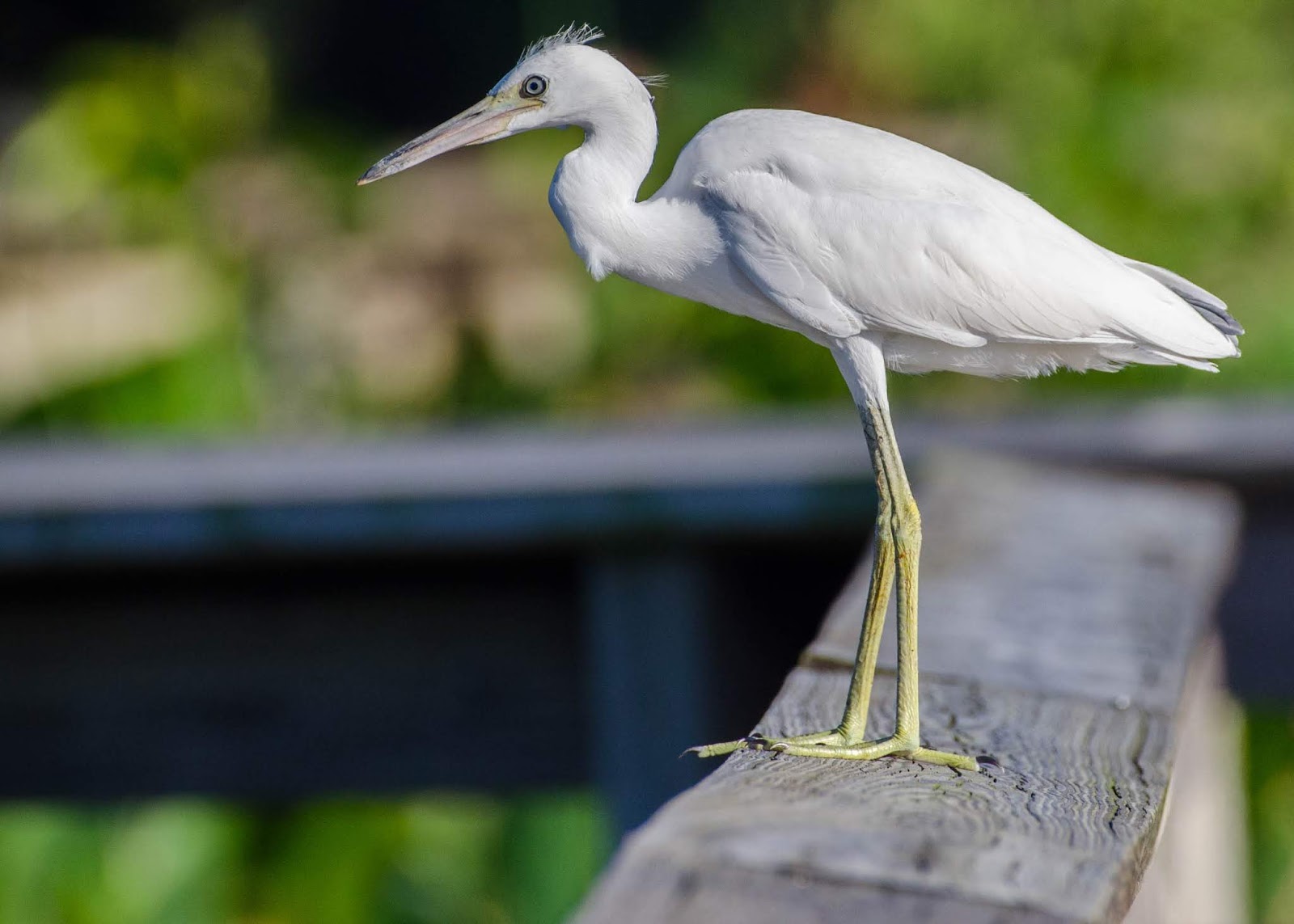
Here is a fresh fledged little blue heron. Little, but still needs to mature to earn that blue!


Love that downy fuzz!

If you love herons, then you'll love Florida. Because they are everywhere, all the time.
Here a great blue atop a nest.

Also, if you love iguanas, you'll love Florida, they are everywhere.
(I LOVE iguanas)

To the point, these invasive exotics earned exterminator rights.
As we drove south bound, I saw a sign, "Got iguanas?" A big stupid smile crept across my face as I made my excited gasp sound that while driving usually terrifies Tim because he thinks something awful happened/is about to happen. And then I frowned and made a sad noise as I continued reading the phone number and "Iguana extermination, call today!"

A bird I missed last year in Brooklyn! A Least Bittern! So little and so handsome!

The one gator we spied in this walk. Just hanging with a group of white ibis, presumably escaping the heat by seeking refuge in the shade and on the grass that's probably more refreshing than the water.
Also hanging around were iguanas. ANd I didn't note the big guy in the background until I reviewed my photos! Looks Spike-worthy in size (Spike was my late iguana of 15 years).

Anhinga in allllll it's glory!

On this visit we also got to see black-bellied whistling ducks, tricolored heron, green heron, white-winged doves, glossy & white ibis, cattle, great, and snowy egrets, belted kingfisher, and never-ending common gallinules.