Friday, June 3, 2022

Plover Love

     So I have been unemployed since April 29th and keeping myself busy and contributing to the world by volunteering with NYC Plover Project. It's been a very exciting experience that has my heart and soul invested in these little birds. I have felt everything from pure joy and wonder, to curiosity, and even worry and sadness. Being that these are wild animals, the natural world is tough living and I have had to remind myself that while I am absolutely in love, it's not easy being a plover!

    Thankfully, people on the beach, for the most part are understanding, receptive, and thankful to learn more about these birds and help them stay safe. But I feel so fortunate to have this window into their little lives (from a respectful distance) and see things I have never seen before, their behaviors, their calls, their tenacity, and determination. Plus, all the happenings that go on around them, bottlenose dolphins, various shorebirds coming and going, my first winter skate egg case, and all kinds of mysterious things washing ashore from fish to ctenophores.

    These birds have inspired me a ton, and the work volunteers and Gateway Biological Techs have been doing blow me away and give me hope for the little birds. I am proud to have helped build exclosures around their very tiny, hidden nests, seen babies on their first day of hatching, and seeing other couples going through the motions of courtship and nest building,

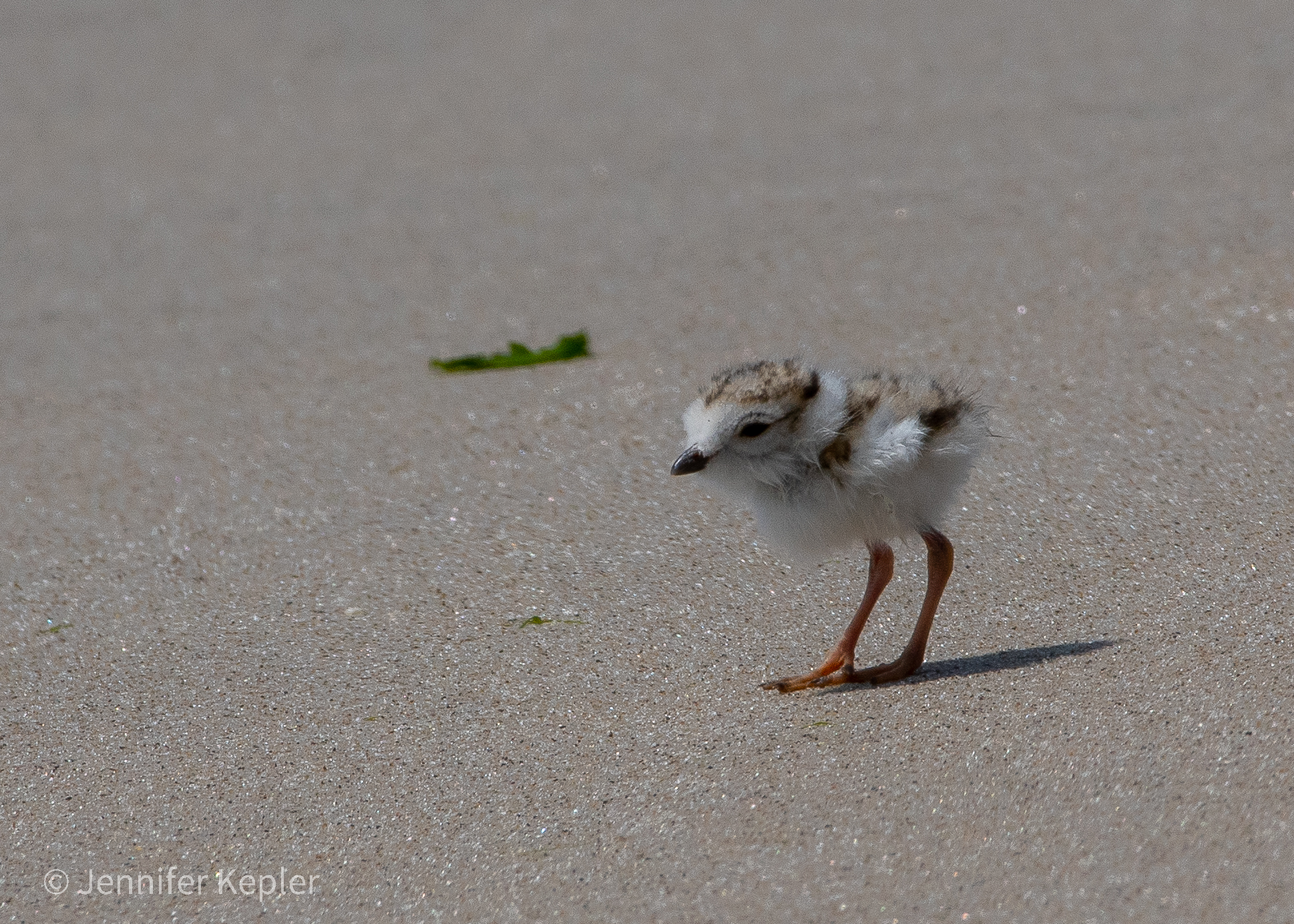
Here is a chick at not even a full day old.


Unlike songbirds, piping plovers can walk soon after hatching. They are called precocial, similar to how baby chickens operate. They can walk and feed on their own, but cannot fly, so they still need mom and dad around to provide protection and to learn about being a plover from!

The grownups have to eat and refuel a bunch, they have a lot of chicks to wrangle!

The chicks zip around pretty quickly.

In just a few days they are really on the move (and extremely cute).

Even the birder who refuses to call birds "cute" surely cannot resist attaching that descriptor to such a tiny little floof.

Literally no bigger than a golf ball, these little chicks are susceptible to gulls, racoons, even the ghost crabs that scour these sands.

But other big, unnatural threats include the things we do. Simply walking the beach, these babies crouch when they feel threated and hope to blend in. For people, we barely notice and babies risk being stepped on (I know the thought alone hurts my heart).

Our pets also pose a giant threat to them. Cats are NOT part of nature, we put them there and they are relentless killing machines. Pet dogs, leashed or not, also are a threat, they trample chicks unknowingly, and the ones who do notice the chicks find them irresistible to chase. And dogs in an area could cause parent birds to risk their lives trying to distract what they see as a predator.

Trash is also a problem. While a baby bird may not eat the plastic behind it, the copious food wrappers and debris left by people attract rats and raccoons in higher volumes than they naturally should be occurring. And of course, if they happen upon a chick, its Bon appetite. 

So want to protect some little babies? Easy.
Leave dogs home.
Leave kites home.
Be aware they live here, look for them and give them space.
Stay out of the dunes, this is their refuge!
Take your trash home with you - don't even bother with the trash cans, take it home and dispose of it there.

Also, just tell other people about these cuties and how to be a good neighbor to wildlife!

Footprints for scale, living on NYC beaches as a plover chick is like playing in a busy street.


On another day this week I felt fortunate to see the courtship behavior of the plovers, which includes the male walking tall behind the female and high stepping and "kicking" her with each foot as he steps. Soon after the pair took turns making scrapes in the sand, a nesting behavior,


A lot of folks think only flamingoes do the one foot up thing, but all birds do it when resting.

I love the contrast of these tiny, seemingly delicate birds who choose to live next to one of the greatest forces this planet has to offer, the ocean.

Sometimes I also get to see some delightful plover neighbors.
This short billed dowitcher is just moving though the area, stopping over for a simple refuel of mole crab.

These birds breed north of here and will return later on in August as they head back south for their wintering grounds.


I also saw my first semipalmated sandpipers arriving. Again, their breeding grounds are to the north. This is just a pitstop, so unlike the plovers, these migrating birds don't quite has the same worries, but they benefit from the protections that are in place like no dogs, no kites, and not trampling the dunes. 

Friday, May 20, 2022

Endangered Species Day

 Today is Endangered Species Day, and coincidentally, I spent my morning looking out for some very special endangered birds right here in NYC. I have been spending some time volunteering with the NYC Plover Project especially as I am in the midst of a transitional point in my career. 

There are less than 8,000 piping plovers left in the world. Less than 100 nest around NYC. New York City is a coastal city, 4 of its 5 boroughs are on islands (Brooklyn and Queens, get over it, geographically, you're Long Island -- just FYI it was very hard to not write the phonetical pronunciation "Lawng Eyeland"). Any who, we have habitat that these birds have used for nest sites, historically and they sure as heck need our help because since people have come along, they don't realize that these birds and other animals are here and how even just little actions like walking near a nest could be life or death for a plover, its future offspring, or chicks.

As always, I will share that the photos I take are zoomed in at 500mm and heavily cropped after the fact. When birds walk toward me I give them space.

A female piping plover along the beach. These birds can practically be underfoot if you don't realize they exist. Their coloration is great camouflage, and it works too well!

Shaorebirds are diverse in size, shape, and structure. The sanderling in front is a type of sandpiper, the piping plover is well, a plover. Both are what we collectively call shorebirds. Sanderlings, unlike piping plovers do not breed here, they breed in the high arctic.

So why are dogs not permitted on beaches after a certain date?
The answer is right here. I promise you that dogs are happy to play and run ANYWHERE. Come to the beach in the offseason (but still with a leash!) and enjoy yourselves. But for spring and summer, please share the shore. Dogs are perceived as predators, even just their presence, walking by your side can cause abandonment of nests and even trampling of chicks.

So what, if a bird is chased off, it didn't get hurt!
The issue here is that these birds running from us, dogs, or anything that is a perceived danger (even if we don't mean for it to be) results in loss of energy. That means they have to find more food and make up for what was lost due to unnecessary caloric burn.

I always wonder what little animals can see that larger animals, like us, cannot. They key in on tiny things and somehow eat it.

This plover was doing a fun little move for agitating the wet sand to stir up potential prey. I call it the foot jiggle, maybe it has a real name. They basically jiggle their foot in wet sand, vigorously. The sand, freshly wet is loose and the agitation can reveal critters that would make a delicious bite to eat, for a plover.

At one point I got caught between two foraging plovers. I backed up from the shoreline onto the beach. The female ran to the male and they did this posturing at one another, standing tall. First she did, then (pictured here) he did. Then they foraged a bit together, and foraged in the same general direction down the beach.
With a warm weekend coming up, surely the beach will be flooded with eager people, who are tired of second, third, and fourth winters that we have had. So I might even stop down tomorrow with the kiddo for a short time to make sure people are sharing the shore and maybe teaching some folks about one very cute, little, endangered bird.

Monday, May 16, 2022

Clapper Rail Appreciation Post

     Whenever we do one of those work icebreakers of, "what animal do you feel represents you best and why," I almost always choose clapper rails. Like them, I'm a bit of an introvert and don't mind being hidden among the chaos of life, but when my voice is needed, I have no problem being loud, I'm a little awkward, and I too love the marsh. There it is, I am a clapper rail.

    Last week, on Friday the 13th, I did a walk around the Salt Marsh Nature Center at Marine Park, I've been hearing clapper rails, but surely more are arriving and not only was that true, but they also were singing their songs of longing and love. Claiming their territory with that "kek-kek-kek-kek" call, but also a number ending that call with a "kek-kek-kek-kurrrrrr" ending in a trill I honestly don't think I have ever heard. 

    It all started with one rail, screaming it's face off and only got better from there...


Typically, this is considered a most successful viewing of a clapper rail. These birds are very secretive and weave their way through the marsh grasses where they remain under cover, can feed, and even raise their chicks.

I saw this bird just crossing over from the green bridge at the marsh that takes you out onto the main trails. I didn't even get to the first osprey platform before seeing this bird - which I admit is very zoomed in and cropped. Rail spotting is a bit of a challenge. It's mostly trying to look for a (small) chicken sized bird, looking for its movement between the grass blades. It's not easy. But once you have seen them, you get a decent hang of it. Patience is really key.

But this particular bird was not trying to be 100% discrete as it SCREAMED in my general direction. For such a little thing, they have a voice!
I saw at least 6 clapper rails, some right out in the open and it felt like many were claiming their section of the marsh. Many barking their "kek-kek-kek-kek's" back at one another, some even feeling like they resulted in a duet of sorts.
In my heart, I knew this would happen. Low visibility, rainy, foggy, just a cruddy all around scenario for pictures and of course it felt like every clapper rail was on it's own stage, out in the open, just being driven by their hormones to really put themselves in the spotlight. I couldn't grab a single picture, but I did sit on a bench in the rain and take it all in.

As I was leaving, crossing over the green bridge, I noticed the tide was going out. I stopped to admire the greater yellowlegs, the very snazzy looking yellow-crowned night herons, and a pair of boat tailed grackles, make and female even pecked among the muck.
Then I noticed some movement between the reeds.
A clapper rail, practically walking at my feet.
I slowly backed up to give the bird some space, but they seemed to keep carrying on, dipping their bill into the puddles and mud. Even remaining as other people walked by.

Like, you really cannot ask for better views of this bird. So, naturally I devoured this moment.... but made sure to take my time and savor it all.

If you are familiar with chicken breeds, these birds remind of a bantam sized chicken on stilts with extra large feet (and bill, of course). They are not very big at all and as the marsh grasses reach their way towards the sky, moments like this will become harder and harder, they still could happen but, it gets harder!

Those awkwardly large feet are actually a helpful adaptation to life in the marsh. No worries about sinking into mud as it can distribute weight (think like snow shoes!), and also helps these birds walk over rafts of reeds and through grasses especially as the tides roll in.

I even got a nice leg and wing stretch.

Still remaining close, the bird peered around every corner as it explored between the grasses.

From head-on, they are very bowling-pin shape in appearance!

As I mentioned a number of people walked by and the bird hung tight.
It wasn't until a dog crossed the bridge. An animal that is perceived as a predator, and despite being on leash and showing zero interest in the bird caused the bird to spook and run. The impact of just the presence of a dog was quite large! Now think about the dogs that owners let run free where control is fully relinquished. It does a great deal of impact on all wildlife, extending beyond little birds.
Please keep pets leashed and always on trails if you do wish to enjoy the outdoors together.

The rail ran for cover and distanced itself from the bridge after the dog crossed.

It was from there our time ended. One last run in the clear as it strutted into the thick of the marsh, toward the first bird I saw, yelling, when I first entered the trail.
What a special time, I will never, ever, get tired of clapper rails!


Sunday, May 15, 2022

The Last Week and a Half...

     I've been keeping busy the last week and a half, it was the kiddo's SECOND birthday, I had some chances to volunteer, and more. And in between it all, I got out to enjoy some birds. I'll admit, it's felt like a really slow and not super fruitful migration, but still, there have been some stunners and some wonderful moments. I've also taken my daughter out of a walk at the nature trail at Marine Park and we had the chance to not only look at birds, but collect rocks and sticks (which all now live in my living room). She is super curious about the outdoors and blows to kisses to every animal and says "hi," with a wave to everything. It's wonderful to share nature with her and to drop the camera for an outing together.

Speaking of my daughter, her due date was May 5, 2020. So on that day, despite the nerves of my husband, I went birding, in Green-Wood and had the most amazing show of birds while being just about ready to pop (water broke that evening and she was born the next day). So, last year and this year, I went birding on May 5th, always hoping to re-live that memory. Hopefully one day, she will do it with me.
Anyway, it was extra special that on this outing to have a gorgeous prothonotary warbler visit!

Also, an extra helping of rose-breasted grosbeak! Felt like I have seen many males and females this migration. This fella was feeding in this oak - the same one I stood at on May 5, 2020 and had an array of warblers fly right before my eyes.
I'm not religious, at all. But I find it insane how when it comes to nature, I very much treat certain places as sacred, and come back to them because of a moment I had there.

Oh, and he sand a little tune between mouth-fulls!

Had many a wood thrush this day and ovenbirds, often in the same places. They kind of occupy a similar role of feeding upon insects o the forest floor so it's no coincidence they look and act quite similar.

Not as big a day as I had in 2020, but still perfect. I'll take it!

The weekend that followed, May 6th and 7th, we had some rainy, windy weather. On Monday, I did Plover Patrol with NYC Plover Project and saw so much erosion and a sad scene. I had noted many oystercatchers sitting on the sand and paired up. Many on what I assumed were nests. Well, for some who nested closer to the ocean, the waves literally came up and washed away a few nests, as evidenced by this egg, not a single adult nearby or frantically calling. This egg (and a second nearby, likely from the same clutch) was abandoned and probably gone.
Nature is tough on these animals, and with rising sea levels that puts a whole 'nother kind of pressure on these birds, plus human activity, because, we love the beach - so I am happy to be part of helping to teach people about how to best share the shore.
Many of the sanderlings on the beach are getting into their snazzy breeding plumage. They go from the white and gray look to this rust-red color. They look like a completely different bird!
On Monday, the winds were still quite, well, windy. The surf was impressive and all the piping plover I saw were in the dunes or behind the symbolic fencing (these are the string barrier put up around the dunes that people are asked to stay out of, to protect these endangered birds and others).
This plover in particular was quite sleepy, and used this beach wrack pile as a windbreak. 
In the exclosure, the birds were still on their nest, even getting up to chase off oystercatchers who got too near.... which is funny because the oystercatchers cannot get inside -- but good behavior on the parents. Once the eggs hatch they will have to really work hard to keep their mobile chicks safe!
The only birds I saw in or near the water on Monday were American Oystercatchers or Sanderlings - who even they were not getting as close as they normally do as the waves were big and fast!


On Wednesday last week, I did some more plover patrol, but tried out Breezy Point. There were a nice showing of them there! Many down at the water, foraging among the waves as they lapped up onto the beach.


And of course, darting their way from place to place or out of that one wave that they thought was going to not come up quite that far! I love how each bird is distinct, their black markings are various thicknesses and lengths. Some with marking that seem barely there...

...To others who nearly have a full collar around their neck!

I also saw, in addition to piping plover, two other types of plover, black-bellied plover and this, a killdeer! Both of which are much larger than the piping plovers!

My heart skipped a beat as this one plover hopped inside this horseshoe crab shell! Oh the significance these chelicerates have to the lives of shorebirds who visit our bayside beaches.

Folks wonder why these birds are at such risk -- well, take a look.
I generally spot them when I notice sand that moves. They blend in amazingly well, and when Fifi runs off leash on the beach, you likely don't even see the plover she disrupts or worse, hunts. 
Or when you're flying your kite, you scare the parent bird off the nest because they perceive your recreational activity as a hawk overhead.
So many folks don't see these birds and especially their chicks, whose instinct to stay safe is to crouch and blend, which can easily be trampled and injured or worse. So please take a look around you at the beach and notice all the critters who share that space too.

Plus, when you do start noticing, a whole world of discovery opens up!

Then, on Friday the 13th, I did go to the Marine Park Salt Marsh. The day was gray, even rainy at times.
I'll tell you, these marsh birds do not care, including these yellow-crowned night herons.

Look at those impressive plumes from their head!

I kind of really hate taking pictures in overcast conditions. But, I might make an exception for this one moment that turned out so (I hate this word, but is is...) whimsical! The delicate dew surrounding this killdeer who is definitely hiding a chick or two under that floof. I took this from the trail, with heavy cropping and zooming and retreating thereafter. 

Ran into another birder who clued me in to the location of a clay colored sparrow. I ventured toward it to discover it stuck it out and was quite happy to land right on the trail that I too was standing on.

I like this moustache look it has going on, when viewed from the front.

Clay colored sparrows can be easily distinguished from immature or non-breeding chipping sparrows by looking at their eye. That brown streak behind their eye ends there. On a chippy, it would continue through and to the beak.

On this day, Friday the 13th, I also had ana amazing show of Clapper Rails. They were so good, I'll leave you with this, a teaser, I'm going to give them a whole post because I love them so very very much!
Also, want to note, this is an exceptionally great view of a clapper rail as most encounters are by sound. But sometimes, you do get quite lucky, perhaps its a quick walk through a clearing in the marsh grass, or a head that sticks out above a raft or dead reeds, or a white twitch of they tail as one crept away, right under your nose....