So I just lived my own childhood dream of living and working in the field with wildlife. I always thought I'd grow up to be a paleontologist, digging up dinosaurs or studying reptiles in the jungle and while that didn't turn out so, I found a great way to fulfill that yearning.
Last December I signed up to become a volunteer on Great Gull Island and between work and personal interest I got to go for a week! So, needless to say, I have so much to share and I am going to do it in a few parts to avoid one giant post:
Here we will begin with what Great Gull Island is, a little bit of its history and what it is currently like there these days. In another post I'd like to share the stars of the island, the terns! Later I will share a bit about the research, what our role was in volunteering there and how we contributed to this on-going monitoring of the colony. And last, a little bit about who else we found there-- because it's not just terns! So strap yourself in for a few posts and please, enjoy!!
Historically the island was always a place for seabirds, but in the late 1800's their populations decreased as a fort was built on the island, remaining active from the Spanish-American War through World War II. Evidence of the military is all over the island, ruins of bunkers and other structures are throughout the tiny island, which is only about 17 acres.
The island was purchased by the Museum of Natural History in 1949 and so began the Great Gull Island project, working to restore the historic colonies of terns that were nearly decimated by the island's period of time spent as a fort.
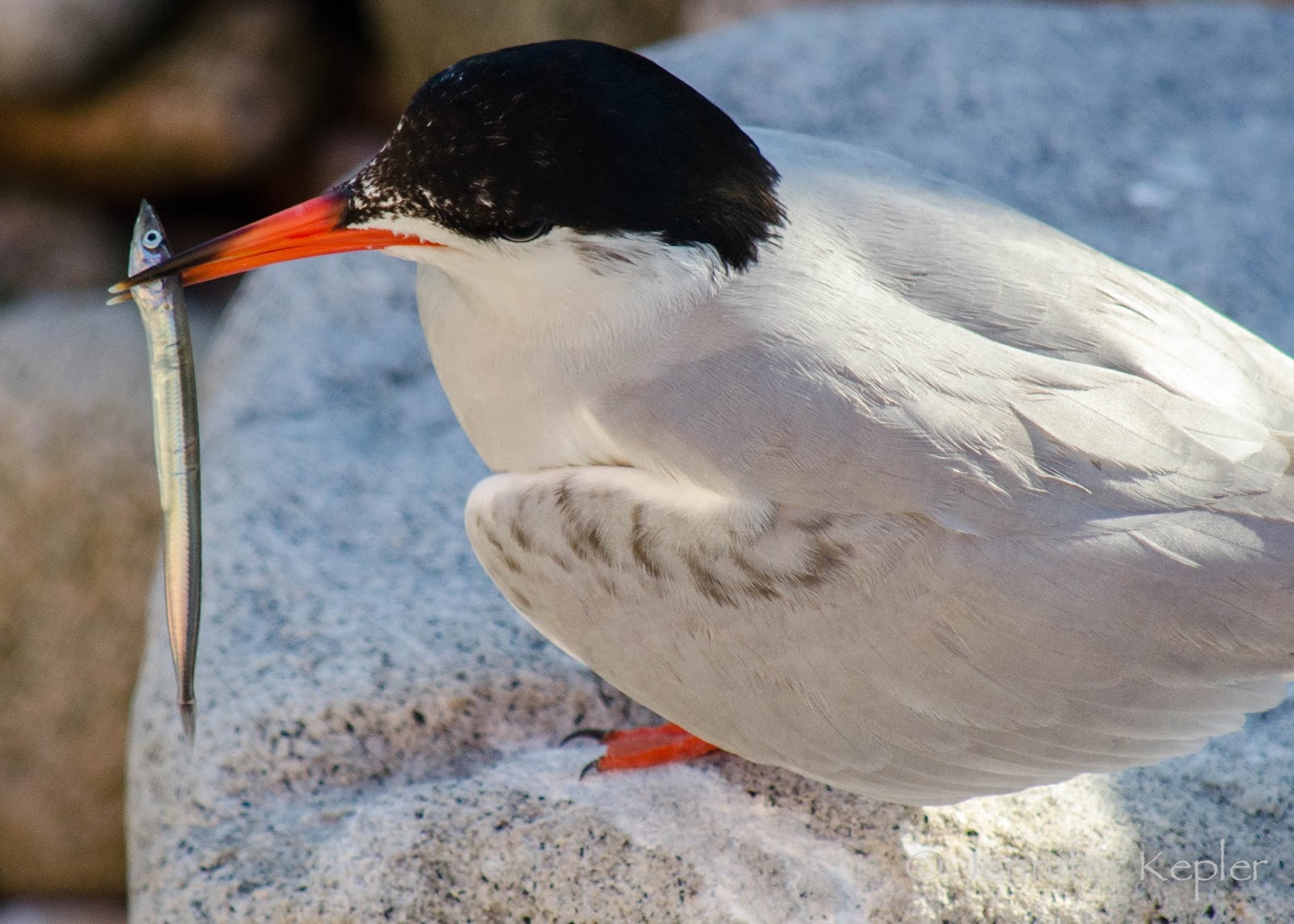
The two species of interest are the Common and Roseate Tern. In restoring habitat and maintaining that habitat, the terns have returned and the pairs on the island have grown over time.
 |
| One cannot just go to Great Gull Island (GGI), we had to board the one boat a week that ferries volunteers, food, mail, and freshwater to the island. The boat is a medium sized fishing boat, a fairly smooth ride. and not going to lie, when the island comes into sight, I felt like I was in Jurassic Park.... but on a boat, and the dinosaurs were flying all around me, and spoiler-- no one got eaten. |
 |
| Also, positioned all around the island are alien-looking white tarp covered blinds. A blind is where one can hang out, observe the birds and not disturb them. Blinds also provide a place for one to hide, and get refuge when trying to trap birds or a place to hang out when there is down time to observe birds and take note of behavior, fish they are carrying in, etc. |
 |
All you have to do is follow the birds to find your way to GGI. A roseate tern leads the way.
The Island is situated on the Eastern part of the Long Island Sound, East of Orient and Plum Island, With Gardiners Island and Montauk to its South, Fishers and Block Island to the East, and Connecticut to its North. |
 |
| A small dock allows a boat to carefully side up to the island, allowing for a swap of volunteers-- those visiting the island and those who are tagging out to return home. Off the boat comes the belongings of the volunteers, groceries, mail, and tanks of fresh water. Onto the boat goes empty water tanks, trash, and bird-soiled belongings of the volunteer crew disembarking. |
 |
| Incoming to GGI with the provisions that included fresh veggies, fruits, eggs, proteins, and most importantly, ice cream! |
 |
| It may look peaceful, but your first steps onto the island are chaotic, everyone tries to move fast but carefully. Birds swoop at your head and delicate nests lie at your feet, every step needs to be made with delicate care and precision. |
 |
| Protecting our heads as we take our first steps onto GGI. |
 |
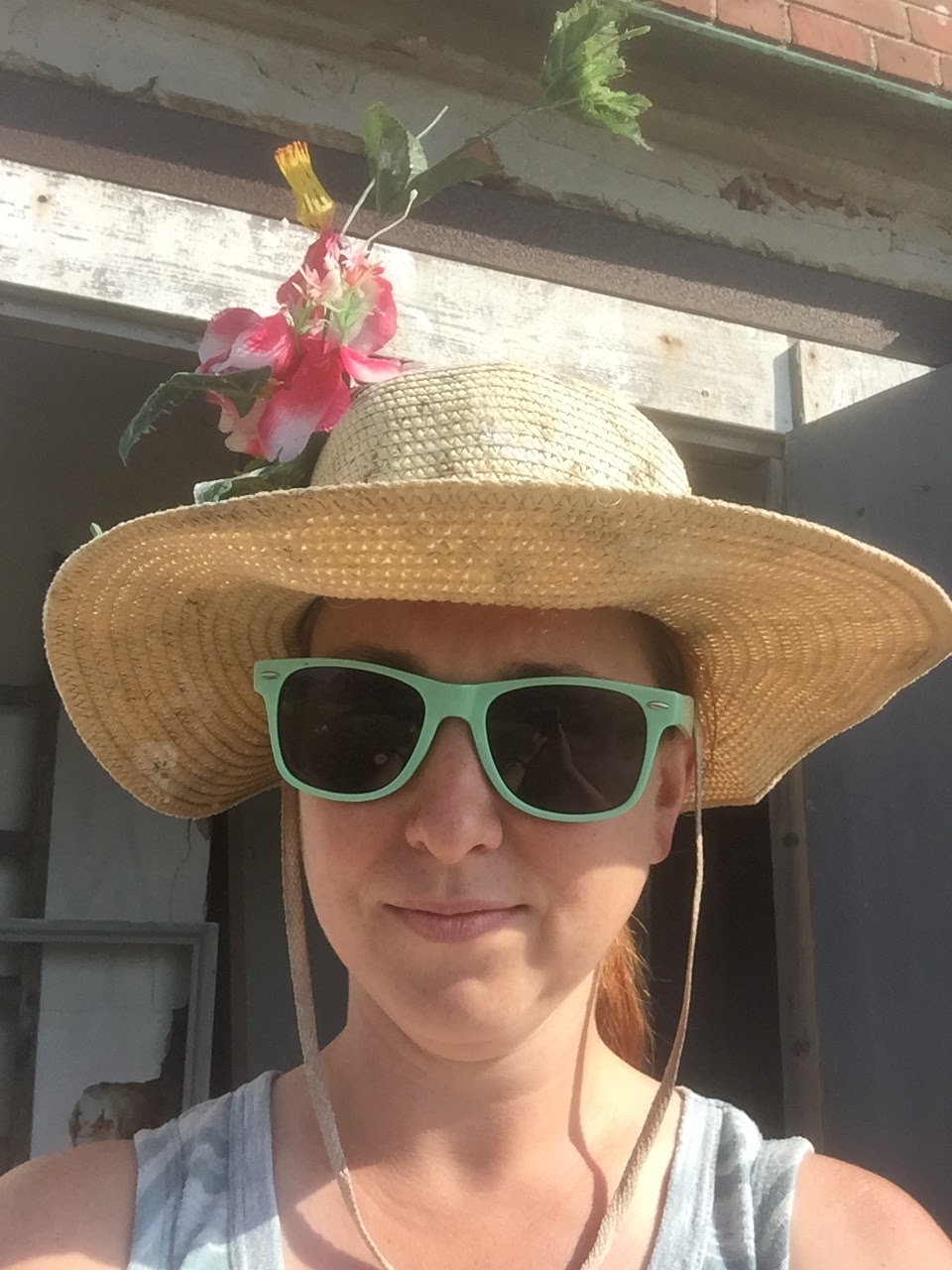
Once upon the island, wide-brimmed straw hats equipped with silk plants are a coveted piece of equipment. From boats surrounding the island, on fishing trips-- we must look like an odd cult on an island with those odd white blinds all along its perimeter, as everyone wears a hat.
The hat protects you from sharp beaks, droppings, and brazen birds who will get all up in your face, all in the name of defending their nests and young. |
 |
| Old barracks become our temporary living quarters. The island has no electricity or running water. At night we use candles or flashlights- and even with use of such light-producing implements, we have to be sure shades are drawn as the lights can attract potential predators like night herons or gulls. |
 |
My coworker and I lived in the room with the patio. Our outdoor neighbors were terns, with chicks. We brushed our teeth out there while also avoiding a beak swoop from an ornery bird.
Since there is no running water, a re-useable bottle was key to always have drinking water available. For washing dishes and hands, we utilized collected rain water, which I honestly had to accept as okay to do. I figured if this has been the method since 1949, it's tried and true. I soon got past that. |
 |
| Without electricity, late dinners were eaten by candlelight, family style. It's the rare type of dinner one can have, where there is no TV playing, just others around you to engage in conversation with. |
 |
| Gasoline? No, but this is what our freshwater was brought to us in and what we happily drank from. |
 |
| Our kitchen inside headquarters... looking little, it produced! Zucchini, corn bread, and cobblers whipped up with delicious dinners that involved many fresh ingredients. |
 |
| The work space within headquarters, where were kept our records straight, extra strings of bands could be found, and where you could find Helen or Joe at their desks, |
 |
| This structure, called the "Big Blind," was an awesome place to view birds. It also housed a beautiful spotting scope that we could use to look for birds who had/lacked bands, a place to count and estimate the sizes of fish being brought in, and a place to observe behavior. |
 |
| We always had an afternoon break, one could nap, fix a lunch, read a book, or go down to the water and do it all. I was very proud of myself for taking this ladder down to some rocks to get down to the water. I am scared of heights and wobbly ladders that balance you over large boulders, so I am proud of myself for doing this a few times! |
 |
| This little rocky space was my favorite, you could sit in it and get used to the chilly water. Once used to it I had some amazing camping soap that I used to clean up with. It worked as shampoo and soap. I even got very adventurous, I sampled some delicious seaweed (it was tasty!) and used the seaweed as a scrub (people pay for spa seaweed scrub treatments-- it's free in the ocean!). So I was happy not to have to touch my solar shower- the biodegradable, plant based soap I used did a super job of making me feel pretty good and clean. |
 |
| Next to GGI is Little Gull Island-- which is where the big, bad gulls live. The island also houses a light house that has a fog horn that seems to be used at all hours of the day, except when it is truly foggy. |
 |
A true treasure of GGI is Helen Hays. She came to GGI in the 1960's to assess the tern populations and then returned each year since, to monitor the birds and live on the island among them.
She is such a beautiful human being, good-natured, and doing what she loves-- but sharing it with others. She loves these birds and it was an absolute pleasure to be taken under her wing, so to speak, for a week and learn from her about what they do on the island.
Helen is awesome-- so much so that even the Times wrote a piece about her in 2012. |
 |
| A drawing on the workspace table. Helen would make announcements on the headquarters PA system, often in rhyme, which I appreciated. One of her more famous ones, "No more napping, time for trapping!" announced when the afternoon session of trapping adult tern pairs commenced! |
 |
| A bunch of us volunteers from the Common Tern project, one volunteer from the Roseate tern project, and the amazing Helen! Credit to Loy who shared this photo with us all! |
 |
| One thing is for sure, surrounded by birds on this otherwise un-human-inhabited island, a week went by where I forgot I was in New York but felt more like a remote location on the ocean. Birds worked through the night, calling to their mates, their chicks, and warning the others when danger was present. It was amazing to forget where I was and be immersed in this historic field work that is the Great Gull Island Project. |