I took Friday, March 18th off from work as I had worked the Saturday previous. I like taking a random weekday off and traveling somewhere to do any kind of wildlife watching that I can. I decided to go out to Suffolk Country and to check out the barrier beaches that Dune Road travels along, out near Quogue and to perhaps get a glimpse of eagles in Riverhead.
I headed out with one of my wonderful birding friends early, as it takes close to 2 hours to get there. We arrived to wind, wind, and more wind. Strong wind is never good. We got some great dermal exfoliation as we were pelted with sand along the beaches. I also learned the hard way that Honda Civics cannot drive through sand as I tried to park on a small semi-paved road, I got stuck in the part that was not paved.
I owe my friend, as we went into survival mode- I have a shovel in my car, we dragged planks of wood over and attempted to get my car out, instead having to surrender to a quick tow out. We fast forwarded our adventure to Cupsogue and Riverhead, as sand fell out and small pebbles freed themselves from the different components in the front of my car. I always try to make my adventures memorable- the memorable moment for today was totally getting stuck in that sand pit, as the birds were not plentiful with the wind blowing so strong- but we did get some other wildlife sights to make the day feel worth that 2 hour drive...
Enjoy:
 |
One thing I am pretty sure about is that wherever it is that Tim and I decide to call home in our lifetime, it needs to be near the ocean. I love it for wildlife watching, I love it for summer, I love it for the food it provides, I love it for the career it provides me withe- I adore living near a marine habitat.
Here you are looking at the mainland of long island from the barrier beach that Dune Road travels from the Hampton Bays to Cupsogue Park. This island of sand protects the mainland from strong waves, giving Shinnecock Bay a different feel and habitat from the Atlantic less than 1000 feet across the island. |
 |
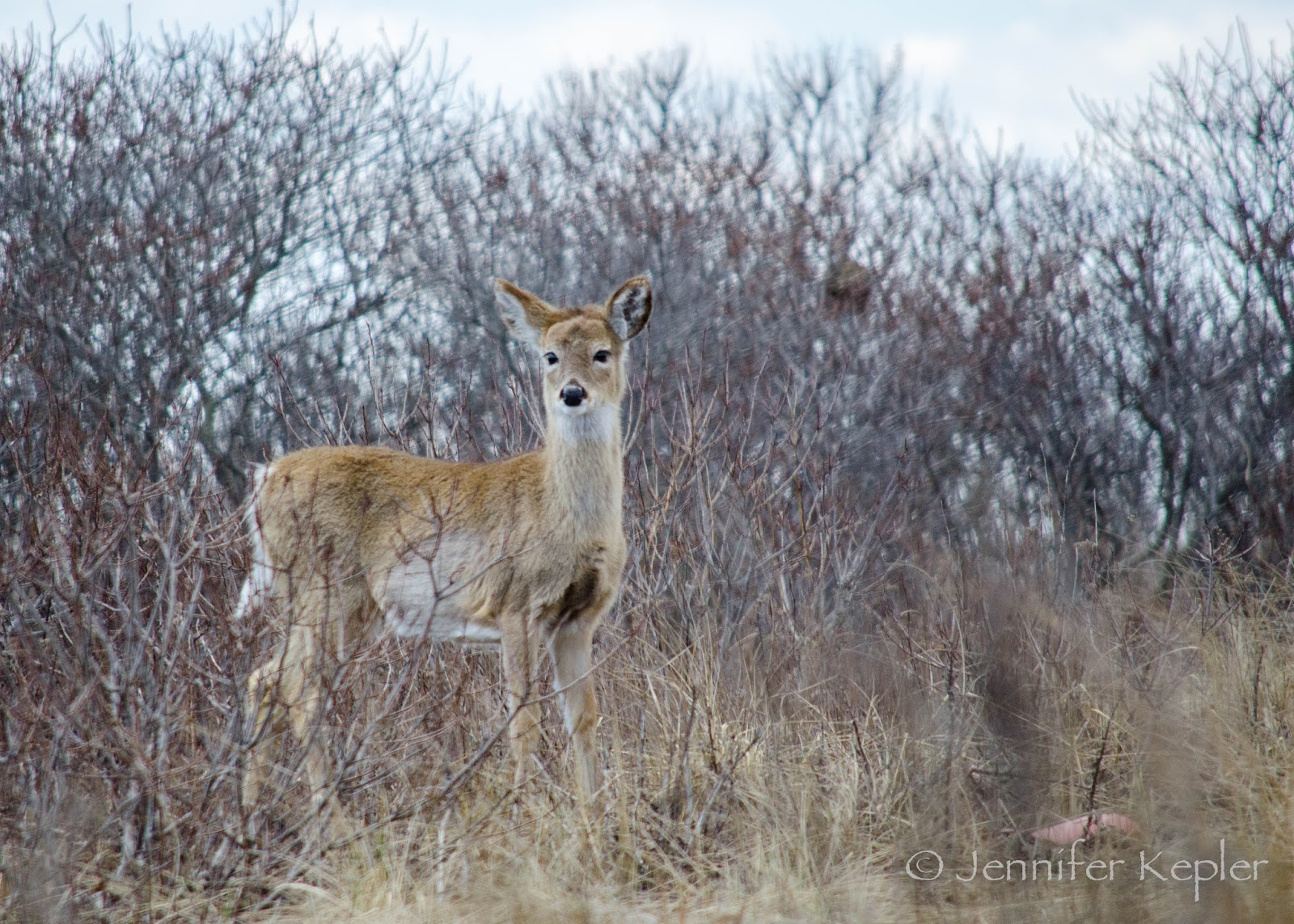
| Deer are not uncommon in Sufflok County, there are no natural predators, so they get to go anywhere they please. |
 |
| Starlings will soon be shoo'd away be the Osprey who nested here last year- if it made the two-way journey successfully. |
 |
| This was one of two withe tailed deer-- that also reminded me of ticks, thankfully I came across none on myself this time around. |
 |
Atlantic Bay scallops are harvested in this area- and I think this is proof. When settlers first came to Long Island and Manhattan, they saw pearly white, lining the shores, as shell middens were not an uncommon sight. Shell middens are formed as debris is dumped at a specific site, usually associated with villages nearby. Since those indigenous to Long Island had easy costal access, shellfish and other marine wildlife were plentiful in their diets, so shell middens were formed as oysters, clams, scallops, and other bivalves were an easy source of food.
So here is a shell midden that is associated with modern civilization... and now that I have reminisced about history, I want to eat some scallops. |
 |
| Rock and roll is not dead on Dune Road... found this huge broken up slab of concrete with the names of different singers and bands on them. |
 |
| ...It's kind of awesome. |
 |
| Oh deer, these deer were not one bit shy near us. They just kept doing their thing. Mind you, these photos are cropped, zoomed in, as we did mind our distance. |
 |
| What sweet-faced, tick-carrying critter they are. |
 |
After getting stuck in sand-- an hour or so later, we got to Cupsogue where we found this. This is a dog swimming with seals, see that little dark thing up and to the left? That's a harbor seal. Letting this happen is a violation of the Marine Mammal protection act and this was reported. If you see marine mammals or see people interacting with them in the wrong way it is best to contact the proper authorities, which is what I did.
Marine Mammal Protection Act: http://www.nmfs.noaa.gov/pr/laws/mmpa/
Riverhead Foundation for Marine Research and Preservation (To report sightings/harassment of M. mammals): http://www.riverheadfoundation.org/ |
 |
| The wind pushes back the waves as they roll in from the ocean. |
 |
| We found on the beach this young grey seal. |
 |
| We very much kept a large respectable distance, and again, photos not only are zoomed in at 300mm, but also cropped. We especially wanted to keep our distance as this guy was so young, he still had some of his pup fur- that fluffy, not yet waterproof fluffy coat that baby seals sport. You can see it on his front and rear flippers. |
 |
| Grey seals shave a more horse-like face, they are less common on Long Island, as you are more likely to see harbor seals. It was awesome to see this as my first wild grey seal. |
 |
| Male seals can reach a length of almost 10 feet while females are smaller at around 6 feet in length. Pups are born from January to February, this guy was most likely born this year, and is working through shedding that remaining pup fur. |
 |
| On all flippers, seals have claws- these claws are great for helping to pull yourself up out of the water, or to scratch that one itch on your forehead. |
 |
| Unlike sea lions (eared seals), the front flippers of true seals are short and stubby. They are not used for propelling forward underwater, instead they wag their hips back and forth, using their real flippers to move them forward underwater. |
 |
| Those whiskers or vibrissae, help these seals navigate underwater, especially in murky conditions. |
 |
| We stayed and looked at this guy for no more than 10 minutes, we limited our time and gave this seal a good distance so it would not flee or feel threatened. It is only my hope others who may have encountered this young guy did just the same. |
 |
| No eagles in Riverhead, but plenty of sea gulls... the herring gulls were quite handsome, looking sharp for the spring. |
It wasn't a waste of an adventure, it was so great to see the seals and escape the city for the day. One thing that is important to remember when going out to look at wildlife is that it is unpredictable. The wildlife isn't confined, it can hide, leave an area and do as it sees fit, especially when the weather is cruel. So I feel privileged to have seen what we were able to see, in the end. I am looking forward to the next adventure where ever and whenever that may be!