Saturday, August 18, 2018

Marbled Godwit

     I like big birds and I cannot lie, you other birders can't deny... when marbled godwit ends up on the tip of Breezy Point, just a quick bike ride away, you don't dip out!
     While ripping off a Sir Mix A Lot song may not be my thing, I really do like me some big birds. Don't get me wrong, I love little warblers, gnatcachers, and swallows-- but I also love and take great joy in observing large raptors, a large shorebird, or a duck. My definition of a big bird is anything larger than a thrush, and part of the reason I may take a favoring to them is because you can look at them without binoculars and watch them even more so interact with their environment-- you are not limited to just the field in your binoculars.
     So, when a Marbled Godwit - this falls into the larger shorebird category for myself - is on a local beach and has been hanging steady, a life bird, accessible by bike-- you go get it! Off to Breezy Point I went...
Not a bird, but happy to see so many Monarchs in the air... this one is on Poison Ivy.

Lots of rain means lots of puddles-- it has been a rainer than normal summer and these puddles attract birds. These puddle birds, in the 4-wheel drive lot on the beach, are lesser yellowlegs.

With the Lesser Yellowlegs was also this solitary sandpiper, a nice surprise!

Okay, small bird exception-- although- they are not that small-- I love terns. A common tern prepares for a good...

...long stretch of the wings. Those wings best be ready for a long flight down toward Brazil and Argentina for the winter!

Smile!

Don't they look like little hustling commuters, trying to get to work on time? A ruddy turnstone, left and a semipalmated plover, right.

Go little turnstone, go!

I liked this juvenile laughing gull in its soft brown tones.

Ever wonder how a bird gets water proof feathers? The preen gland or uropygial gland is how! A waxy oil is collected by surrounding feathers that the beak is then rubbed over to then spread to other feathers.

Target bird-- a marbled godwit that thinks it is an American Oystercatcher.
That beautiful, upturned, thin bill, tall on twiggy legs, I was so stoked to see this bird in person!

This bird is either non-breeding or immature as indicated by its plumage and bill color.
Many folks think of Spring and Fall as migration times ... truly many birds get their migration south starting in August as they have bred in late may through June, with their young grown- it's time to head to their wintering grounds. This bird migrates and breeds in the grasslands and into Canada, on the side just East of the Rockies. They generally don't hang in NY, but this one perhaps got off track a bit- it's winter destination is the Southeastern Coasts of the United states and/or the coasts of Mexico and Central America.

A semipalmated plover taking a rest in the sand- saw 3 plovers on the beach yesterday, semipalmated, piping and black-bellied.

A stone-standing, sleepy ruddy turnstone.

 A great black backed gull eating a discarded dogfish.

Worlds largest gull eats the not worlds smallest shark.

More looks at that godwit.

That long bill is for probing, worms, insects, and other invertebrates-- even small fish.

It's also used for precarious preening!

Gorgeous bird- so glad to see it and add it to my life list!

But before we go...

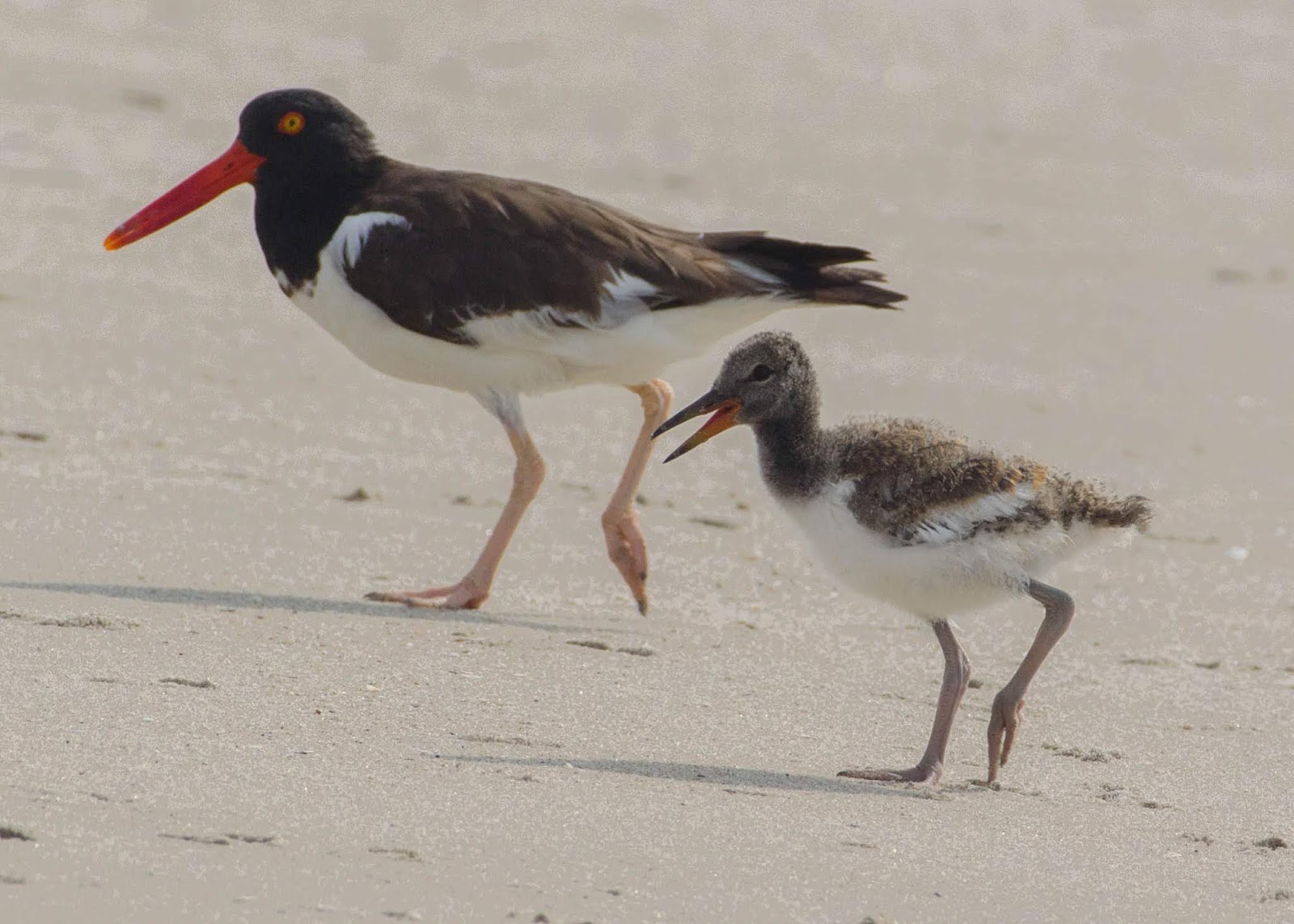
A little tater tot learns the way of the Adult American Oystercatcher.... make as much noise as you possibly can, be loud and proud!

Friday, August 17, 2018

Birding Birdday

     I'm not one for birthday gifts, so when Tim asks me what I want for my birthday, it's usually just his company on a weekend trip to explore somewhere new! I have heard about Bombay Hook Wildlife Refuge and had my sights on that. So, off to Dover, DE.
     What is there to do in Dover, DE? Not a whole bunch, actually- but for birds, it was perfect for a weekend. Aside from birding we did find the Air Force Base in Dover has a pretty cool museum with planes that you can walk under, around, and (on some days- not when we went) inside of. We went into an air control tower, saw flying cargo planes bigger than any plane I have ever seen- all while swallows flew all around. We also visited a brewery, Fordham & Dominion looking for a post birding drink. It was good beer, but they only had a tasting room so we both had lots of tiny beers.
     The trip resulted in 2 life birds for me, lots of shore birds, some rarities to the area and some good company with Tim!
We began at Bombay Hook and after going inside the visitor center, we come out and hear a loud "BOB-WHITE!"
I freak, first bird is a lifer!
Myself, a gentleman parked next to us, who is congratulating me on my first bob white, as he hears me flipping for joy, look for the bird.
Tim spots it- I'm so proud of him for finding it!

Now, at this point, nothing bad can come of our visit to the refuge!

The refuge has a purple martin colony - got to see a few adults and immature birds following their adults.

BIRD OVERLOAD.

I especially loved the large volume of American Avocets here, swooping their heads as they fed in the shallow, muddy waters.

Along the roadside, thistles attracted goldfinch.


This was cool.
We see vultures landing, so we pull up in the car (Bombay hook is a drive with some side trails to hike, unless you have netting over you to keep the insects out, don't hike the trails) and we smell what's drawing them in...
In my pictures the skeleton looks mammalian.
A turkey vulture, left and a black vulture, right - pick at the ripe remains...
It was pretty warm out and if you look at the turkey vulture's legs-- you can see their cooling remedy-- pooping on their legs. The whitewash on its legs are just that. 

Vultures are awesome. For some this might be gross-- but for all, this process and this chunk of the ecological world is vital

Yum Yum Yum!

Not a bird: Common snapping turtle

Not a bird: Red fox

This is my first wild fox, this was exciting. Tim found this gal while my eyes were on birds.

An immature, begging Eastern Kingbird. I love seeing this species.

Not a bird: Red-bellied Turtle

Not a bird: Green Frog

Totally love seeing me some frogs!

On Day 2, I visited Big Stone Beach, where there isn't a beach (well, there is-- it's just not where you go for the birds) but a small dip in the reeds, overlooking a muddy, shallow water area.
I saw reports of a roseate spoonbill-- and there it was!

It fed, swinging its open mouth through the water catching up small crustaceans and whatever is in there.

Also, bonus- an immature white ibis!

So many snowy egrets roosting just above the viewing area. Also, sprinkled throughout were tricolored herons.

And then a slew of glossy ibis flew through, what an amazing contrast in dark and light among the green- such a beautiful sight!

Do you see the white ibis in there??

It was a treat seeing a roseate spoonbill, who after wading flew up and roosted in the trees among the egrets.

On the way back to Dover, we drove Port Mahon Rd-- which seems like if there is a high tide, the road could flood, as we noticed puddles and mud from the beaches flowing out onto the road.
We stopped a few times for views-- DO NOT go onto the beach--- my foot sunk it-- it's mud. So just drive along and use your car as a blind, the birds won't flinch.

Lots of osprey...

... with interesting tenants.

Also, lots of Royal tern- juvenile and adult. This one is a juvenile.
Lots with readable bands too! This one is 799.

Band: 4AP

Fights over favorable perches were the most action one saw on our drive through.
A least sandpiper on the road.
A very successful birdday weekend- I did get to see (not grab a photo) of black necked stilts, another bird I was hoping to see and add to my life list. I was most happy to share this with Tim, he is such a good sport who puts up with and supports my unhealthy obsession with birds.

Sunday, August 12, 2018

Aves de la playa

     Go back two weekends ago and I got in some beach birding at Breezy Point and joined the Feminist bird club for a bilingual bird walk with translation available in Spanish. First I'll begin with the sights in Breezy:

A freshly fledged catbird. I walked the 4-wheel drive path to the beach this day and glad I moved this little one off the path. It sat right in the tire tracks and that walk, 2 trucks came through. This little nugget didn't even budge when I got close. On my walk back it was gone, hidden, and I saw an adult catbird in the same area so I hope this little one ended up safe.

A flagged sanderling-- and didn't get a read.

Sanderlings were the dominant bird (in numbers) on the beach. Lots gathered up past the shore line in large numbers.

A piping plover on the hunt. I love being able to see these birds within the limits of NYC.

Lots of immature birds on the beach, this one a least tern.

And this one a common tern. All of the immature birds sat on the beach begging as their parents flew in with fish, still milking that while they can.

A brown thrasher going through a comical molt. First I thought this a young bird-- and it could be, molting into its adult plumage. Or it could have lice or just a weird molt- as it has been observed that some species go through such funky molts, resulting in "bald" birds. See more in this article by Cornell Lab of Ornithology: https://feederwatch.org/learn/unusual-birds/bald-headed-birds/

A least sandpiper feeding on the bay side of Breezy Point. I just learned today how to access the bay side, and I might be doing so more often, especially looks promising for low tide and exposed flats.

I love these birds, ruddy turnstones, those orange legs are so striking.

Here the ruddy turnstone is turning sand.
 On July 28th, the Feminist Bird Club partnered with NYC Audubon to do its first ever bilingual bird walk. We had a spanish field guide available to identify and learn names of the birds in Spanish. While almost all of our walk was still in English, it was still super great to have this option available for any one who wanted to join us an utilize spanish to identify birds and learn some birding basics.  Also, bonus, it hosted quite a few great bird people, and some new-to-birding folks who got access to some great bird mentors. Here is some of what we saw:
Lots of semipalmated sandpipers running around on the mud flats and in between.

Had a nice flyover of dinosaur--- I mean, glossy ibis.

A short-billed dowitcher, a giant among the semipalmated and least sandpipers.

Fully preening/grooming session among stilt sandpipers.

A more typical look for stilt sandpipers.

A least sandpiper catching little insects on the mud. 
A semipalmated sandpiper-- and on the feet, you can see the semipalmated toes that gives this bird its name.

Not pictured, we were treated to a Wilson's Phalarope on the West Pond, we spent a good chunk of time on the East side, but the West side provided a little blue heron and the phalarope.